Gold Overlay on Silver Jewellery: What It Is, How It's Made, and Why It's Popular in Indigenous Art
- Posted on
- 0
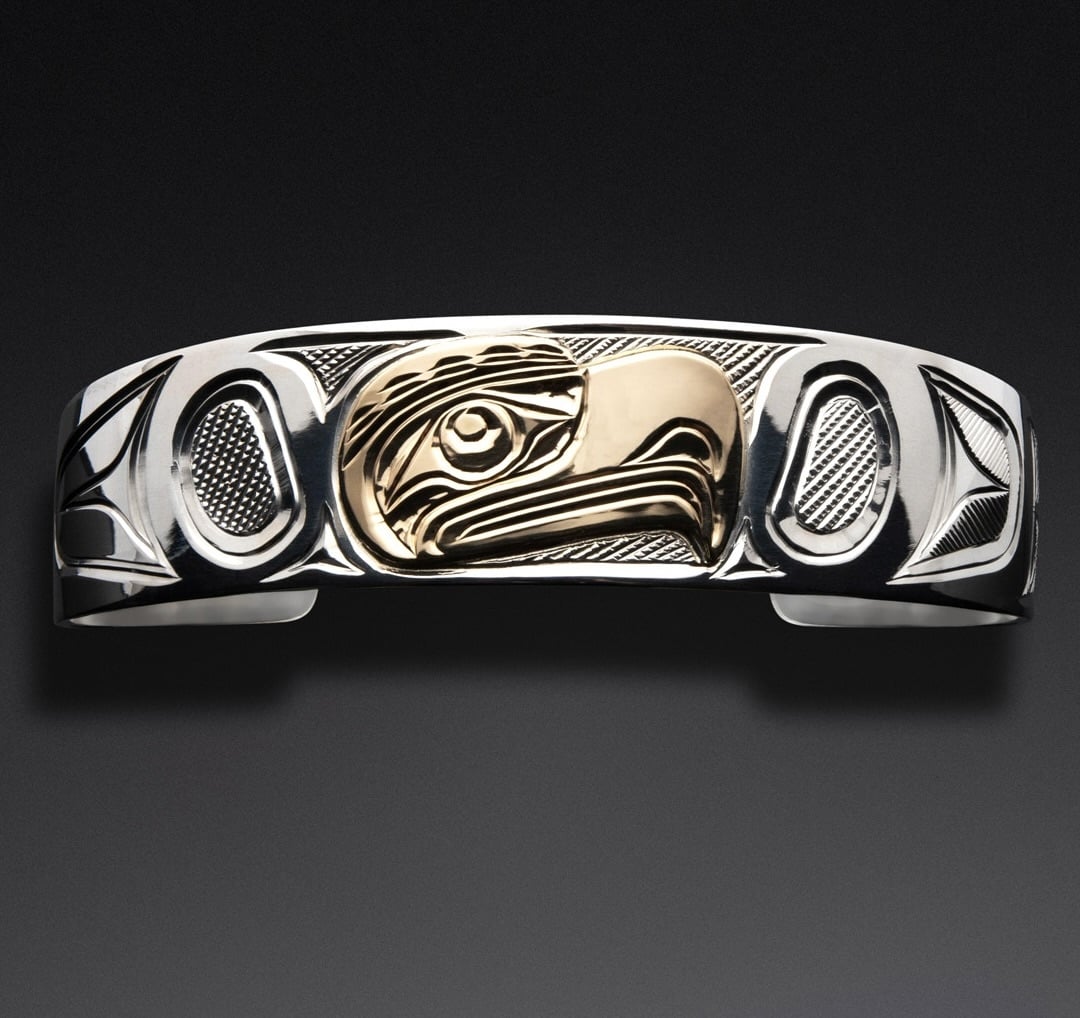
Gold overlay on silver jewellery has become one of the most requested finishes in Northwest Coast Indigenous jewellery. If you've browsed pieces by Haida, Kwak'waka'wakw, or Coast Salish artists and noticed warm gold details set against bright sterling silver, that combination isn't accidental. It's a deliberate technique that adds visual depth, highlights specific design elements, and reflects the artist's intention for how a piece should be read.
This guide explains what gold overlay is, how it's applied, and why it works so well with Northwest Coast formline design. If you're trying to decide between a fully gold or silver piece, or if you're simply curious about the craft behind the jewellery, this should give you a clearer picture.
What is gold overlay on silver jewellery?
Gold overlay, sometimes called "gold on silver" or "two-tone jewellery," refers to a technique in which yellow gold (or sometimes rose gold) is fused, applied, or inlaid onto a sterling silver base. The result is a piece that uses both metals within the same design, typically with each metal occupying a distinct area of the composition.
This is different from gold-filled jewellery (where a thick layer of gold is bonded to a base metal under heat and pressure) and different from gold-plated jewellery (where a very thin gold layer is applied by electroplating). In Indigenous Northwest Coast jewellery, gold overlay is most often achieved through direct application, inlay, or fabrication techniques where the artist controls exactly where each metal sits within the finished piece.
The term "gold on silver" is also commonly used, and both describe the same visual result: a silver piece with gold accents placed with precision.
How gold overlay is applied in Northwest Coast jewellery
The specific method varies by artist and piece type, but several approaches are common in Northwest Coast metalwork:
• Fabrication and soldering: Gold elements such as small overlays, inlaid pieces, or raised sections are fabricated separately and then soldered onto a finished silver base. This gives the artist precise control over placement.
• Inlay: Recessed areas are cut into the silver, and gold is set into those recesses flush with the surface. This technique is common in bracelet work, where the gold sits within the formline design rather than on top of it.
• Repoussé with mixed metals: Some artists use repoussé (hammering from the reverse side to raise the design) in silver and then apply gold leaf or gold wire to specific raised sections of the design.
Whichever method is used, the result is permanent. High-quality gold overlay on silver jewellery is not a surface coating that wears away. The gold is structurally part of the piece.
Why Northwest Coast artists use gold and silver together
Northwest Coast formline design relies on contrast. Haida, Tsimshian, Gitxsan, and Coast Salish designs consist of flowing ovoids, U-forms, and primary and secondary figures, which are understood through the relationship between positive and negative space and the hierarchy of design elements.
Gold and silver directly serve that hierarchy.
In many pieces, silver forms the base and ground of the design, while gold is reserved for specific high-emphasis elements: the eye of an eagle, the dorsal fin of an orca, a central ovoid, or a key accent within a crest figure. The warm gold pulls the eye to exactly the areas the artist wants you to focus on first.
This is not just decorative. In the Northwest Coast visual tradition, the placement and emphasis of a design element communicate meaning. Gold overlay gives artists another tool for structuring that visual hierarchy without relying on scale or line weight alone.
It's also worth noting that gold has long been used in Northwest Coast art for its prestige value. Historically, copper was the most prized material in the region, used in ceremonial coppers that represented wealth, status, and family honour. Gold carries a related weight in contemporary jewellery: it signals that a piece is significant, that it was made with care, and that the wearer understands what they're wearing.
What to look for in gold and silver Indigenous jewellery
If you're shopping for two-tone Indigenous jewellery and want to assess its quality, a few things are worth paying attention to:
• Clean seams between metals: Where gold meets silver, the transition should be crisp. Blurry edges, discoloration around the joint, or uneven lines suggest rushed workmanship.
• Intentional placement: In quality pieces, the gold isn't scattered randomly across the surface. It sits in specific design positions that make sense compositionally, accenting a feature, defining a shape, or marking a boundary.
• Metal purity: Well-made Indigenous jewellery typically uses sterling silver (92.5% silver) and 14 kt, or 18 kt gold for the overlay. Higher karat gold will appear warmer and more saturated against the silver. Some pieces use yellow gold; others use a cooler 14kt white gold, which reads differently against the silver base.
• Surface finishing: The silver portions of the piece should be smooth and consistent. Oxidation (darkening of recessed areas) is often used intentionally to add contrast to engraved areas, but it should look deliberate rather than uneven or accidental.
To see examples of gold overlay work across different piece types, browse the Northwest Coast Indigenous jewellery collection, where you can compare two-tone bracelets, pendants, and rings side by side.

Gold overlay in bracelets, pendants, and rings
Gold overlay appears across most jewellery types, but the effect reads differently depending on the form.
Bracelets
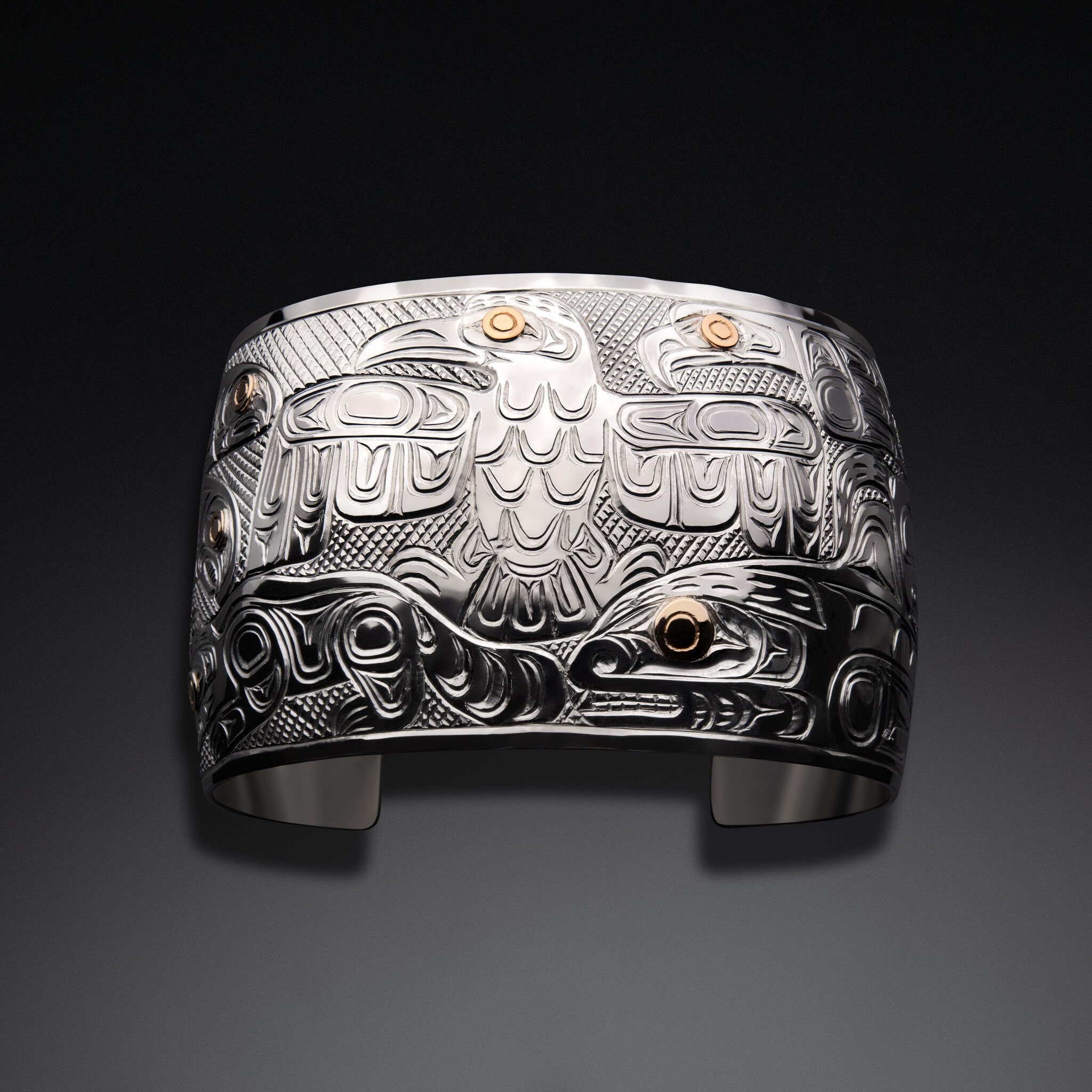
The wide surface of a cuff bracelet provides the gold overlay with the most visible canvas. Artists often use gold to mark the primary figure, the central crest animal, while the secondary design elements remain in silver. This creates a clear focal point across the full width of the cuff and makes the design easier to read from a distance. Northwest Coast bracelets with gold overlay tend to work well as statement pieces worn alone rather than stacked.
Pendants
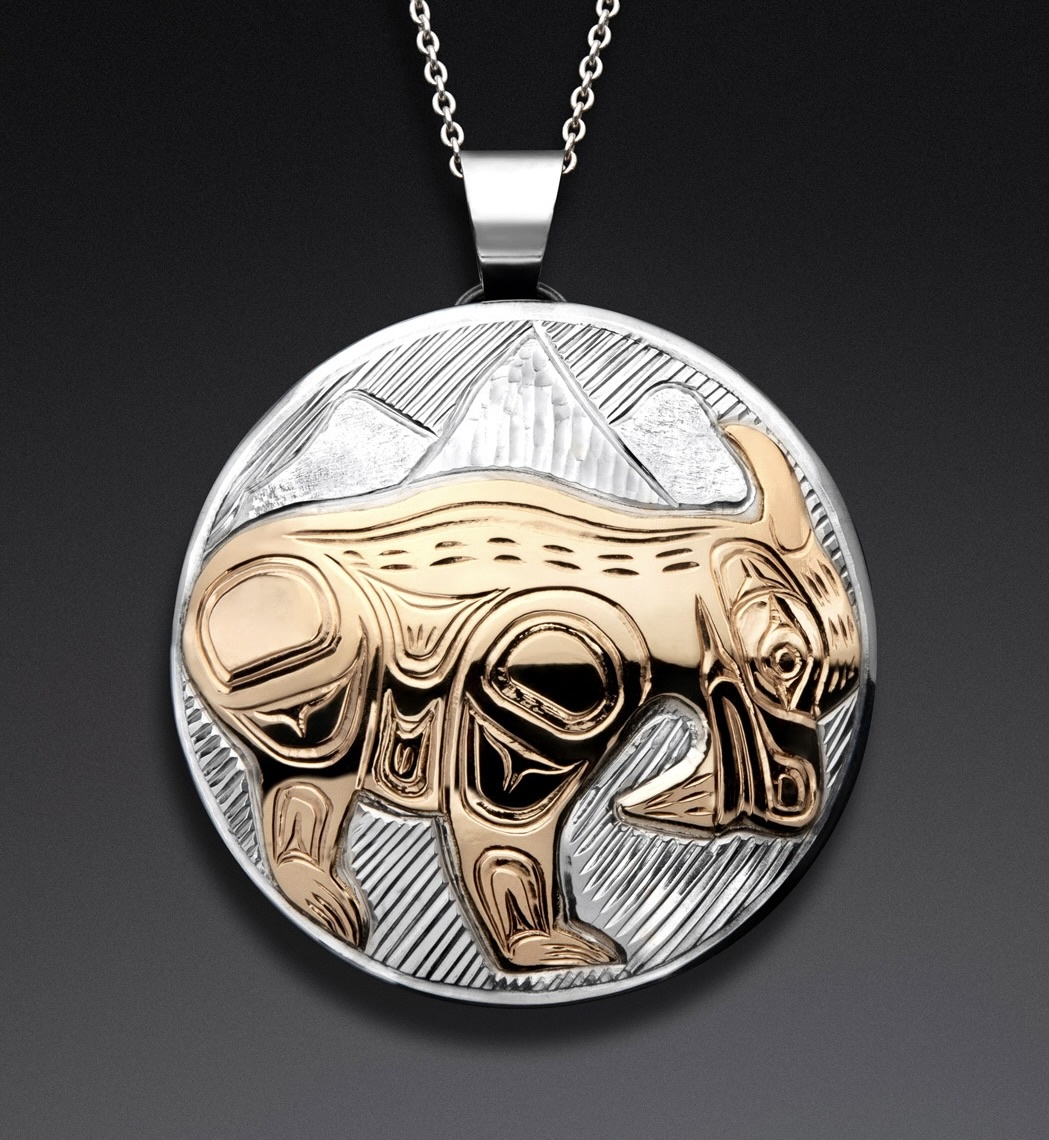
On pendants, gold overlay is often used more sparingly: a single eye, a small accent, or a rim detail. Because pendants are smaller, even a modest amount of gold draws significant visual attention. Hand-engraved pendants with gold detail tend to catch light well and work for everyday wear as well as formal occasions.
Rings
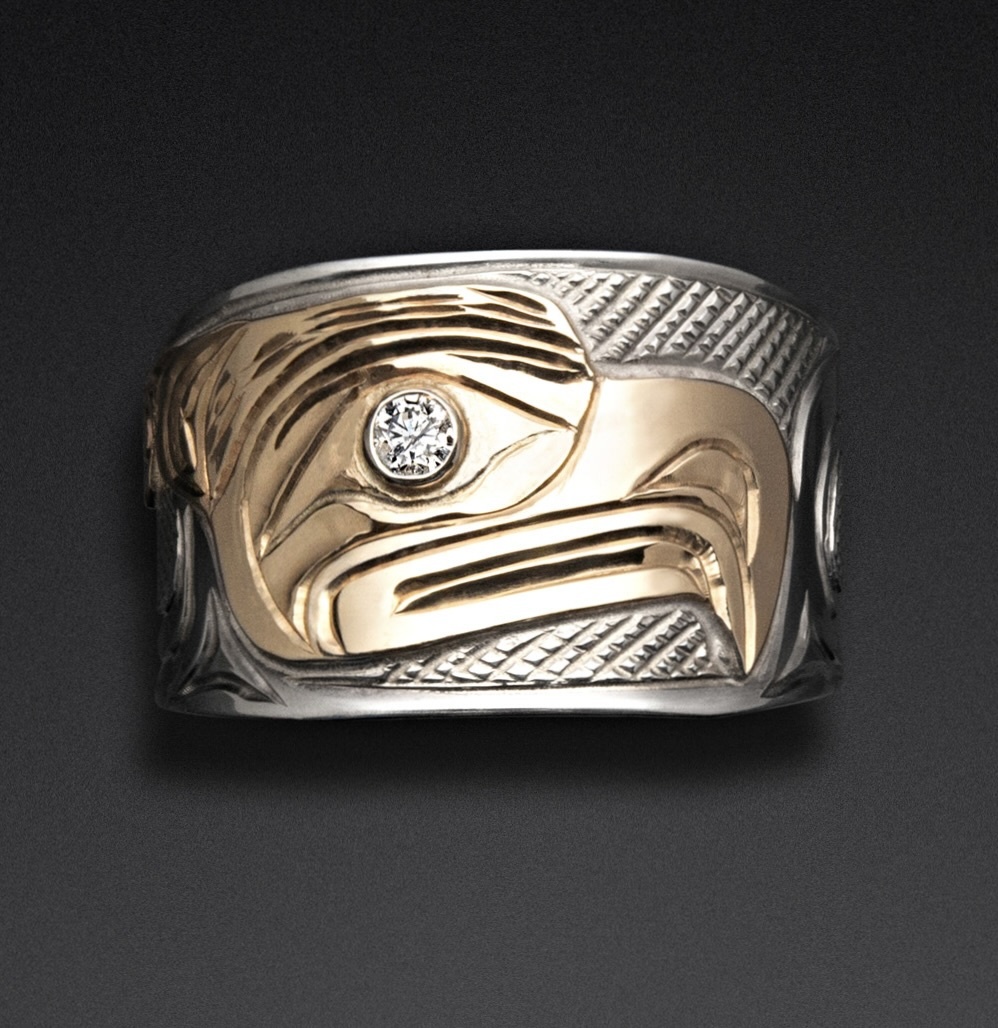
Rings are the most intimate form for two-tone work. Because the finger and hand are always in motion, the interplay of silver and gold constantly catches the light. Indigenous jewellery rings with gold overlay range from subtle, such as a thin gold band inlaid into a silver setting, to bolder compositions where the gold forms a significant portion of the design.
Caring for gold and silver jewellery
Two-tone pieces require a little more care than single-metal jewellery, as the two metals can respond differently to cleaning and storage.
• Polish gently: Use a soft polishing cloth on both metals. Avoid abrasive cleaners that can scratch the silver or dull the gold finish.
• Avoid chemicals: Chlorine, bleach, and strong perfumes can affect both metals. Remove jewellery before swimming, cleaning, or applying perfume.
• Store separately: Keep pieces in a soft pouch or lined box to prevent scratching. Two-tone jewellery scratches the same way single-metal pieces do, but any deep scratch that cuts across the gold-silver boundary is harder to repair.
• Oxidization on silver: If the silver portion of your piece has an intentional dark patina in the recessed areas, avoid polishing those sections. The contrast is part of the design. A general polish cloth on the raised areas is enough.
Find a two-tone piece that fits your style
Gold overlay on silver jewellery is one of the most refined finishes in Northwest Coast Indigenous metalwork. It requires precision, intention, and an understanding of how the two metals will read together once the piece is complete. When it's done well, the result is jewellery that rewards close attention; the more carefully you look, the more of the design reveals itself.
To explore available pieces across bracelets, pendants, rings, and more, you can visit the Northwest Coast Indigenous jewellery collection. If you're looking for a specific design or artist, get in touch directly; many pieces are unique, and new work comes in regularly.
- Understanding "Old Pawn" Navajo Jewelry: What It Means and Why Collectors Seek It
- Navajo Jewellery Symbols Explained: Squash Blossoms, Naja Pendants, and Sandcast Rings
- Cowichan Sweater Gift Guide: Choosing the Right Design and Size for Someone Else
- Custom vs Ready-to-Buy Indigenous Masks: What Collectors Should Know
- Types of Indigenous Masks: Transformation, Portrait and Ceremonial
- The Roles of Singing and Music in Traditional West Coast Indigenous Cultures
- How to Choose an Authentic Totem Pole Carving: A Buyer's Guide
- Totem Poles Explained: Meanings, Types and Cultural Significance
- How to Authenticate Northwest Coast Wood Carvings: Tool Marks, Materials, and Artist Signatures
- The Role of Formline Design in Northwest Coast Carving: Understanding the Visual Language
Share this on:


Comments
Be the first to comment...