How to Choose an Authentic Totem Pole Carving: A Buyer's Guide
- Posted on
- By Cheryl's Trading Post
- 0
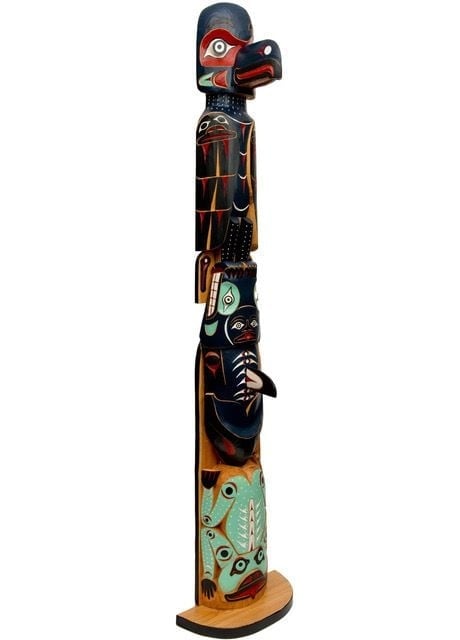
How do you know a totem pole is authentic? An Indigenous gallery explains artist attribution, provenance, and what every buyer should ask.
Most of what gets sold as a "totem pole" online is not a Northwest Coast Indigenous carving. It is a mass-produced decorative item, often manufactured overseas, with a visual resemblance close enough that buyers cannot tell the difference unless they ask the right questions. Most never do.
This guide is for buyers who want the real thing. We are Cheryl's Trading Post, an Indigenous-owned gallery operating for over 15 years. Cheryl is a Gitxsan woman of the Killer Whale Clan, born on the Skeena River. The artists we represent carry their names, are attributed to their nations, and carve out of living traditions. Here is what you need to know before you buy.
Authentic vs. Mass-Produced: What the Difference Actually Looks Like
An authentic totem pole carving from the Northwest Coast is made by a named artist who is a member of a specific nation — Haida, Tlingit, Tsimshian, Kwak'waka'wakw, Gitxsan, Coast Salish, or another coastal people — and whose carving practice is rooted in that nation's visual tradition.
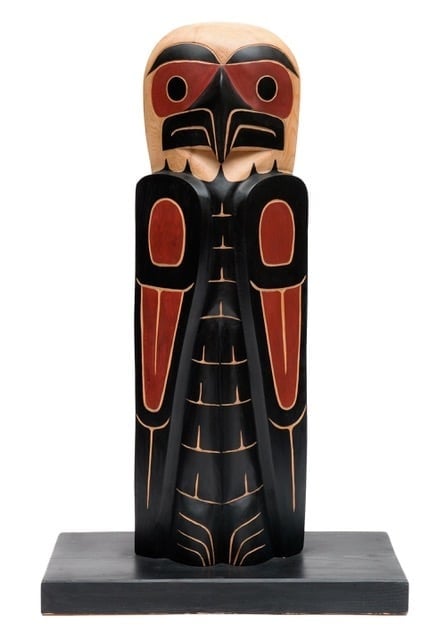
The figures on an authentic carving are crests: specific ancestral images belonging to the artist's lineage or to the nation whose cultural property they represent. The formline — the distinctive flowing line system that defines Northwest Coast design — should be precise, intentional, and consistent across the piece. Formline is not a decorative pattern. It is a visual language with its own grammar, developed over centuries, and irregularities in it are often the first sign that a carving did not come from inside the tradition. Our post on the role of formline design in Northwest Coast carving covers the full visual vocabulary so you can build your eye before buying.
Genuine carvings also show tool marks. Northwest Coast carvers work with adzes, knives, and chisels. The surfaces of authentic work carry a hand-worked quality that machine-produced pieces do not. This is not a flaw — it is part of what you are paying for. For a full breakdown of the visual and material markers, see our guide on what sets authentic Northwest Coast Indigenous carvings apart from mass-produced wood art.
The 5 Questions Every Buyer Should Ask
Before purchasing any piece described as a Northwest Coast or Native American totem pole carving, ask these five questions. A legitimate gallery should be able to answer all of them without hesitation.
1. Who is the artist?
Not just "a native carver" or "a Haida artist" — an actual name. Jay Simeon. Corey Bulpitt. Richie Baker. Someone whose work can be looked up and whose relationship to the gallery can be confirmed. Anonymous attribution is a significant warning sign in any reputable gallery context.
2. What nation does the artist belong to?
Nation attribution is not interchangeable. A Haida carving and a Tsimshian carving look different and carry different histories. The gallery should name the specific nation and, ideally, the community or band — not simply confirm the artist is Indigenous.
3. Is this artist carving within their nation's tradition?
Artists who trained under master carvers within their own communities carry a different level of authenticity than those who learned through general art programs. Ask whether the carver has community ties and whether the crest images on the piece are ones the artist holds the right to use.
4. Does it come with documentation?
A certificate of authenticity should include the artist's full name and nation, the title or description of the work, the medium, and the date. Some galleries also provide artist biographies or statements. This documentation protects your investment and establishes provenance.
5. Can you tell me about this specific piece?
An authentic gallery can tell you something about the carving beyond the price: what figures are depicted, what those figures mean within the artist's tradition, and why this piece was made. If the gallery cannot answer, that is a red flag.
The Indian Arts and Crafts Act and What It Means for US Buyers
If you are in the United States, where many of Cheryl's customers are based, the Indian Arts and Crafts Act (1990, amended 2010) is worth knowing. It is a US federal law that makes it illegal to misrepresent products as "Indian-made" or "Native American" when the artist is not enrolled in a federally or state-recognized tribe. The penalties for sellers are serious: up to $250,000 for individuals on a first offence.
For buyers, the IACA means you have a legal basis for asking any US seller to confirm tribal enrollment for pieces marketed as Native American-made. Suspected violations can be reported to the Indian Arts and Crafts Board at the US Department of the Interior.
Cheryl's Trading Post is a Canadian business. The First Nations artists we represent are Canadian, enrolled in bands and nations under the Canadian First Nations framework, and the IACA does not apply to them directly. What does apply is our 15-year record as an Indigenous-owned business, our membership in the Canadian Council for Indigenous Business (CCIB), and our practice of naming every artist and their nation on every piece we sell. There is no anonymous work in our gallery.
Red Flags When Shopping Online
No artist name on the listing. The most common sign of a mass-produced piece. If a listing says "hand-carved" or "Indigenous-style" without naming a specific artist, that is a flag, not a selling point.
Prices well below market. Authentic small carvings from named artists start in the low hundreds. Authentic mid-size totem poles from working Northwest Coast carvers run from several hundred to several thousand dollars depending on size and the carver's profile. A piece listed at $45 is not an authentic Northwest Coast carving.
"Inspired by" or "in the style of" Native art. These phrases are legal hedges. They mean the piece draws on the aesthetic of Northwest Coast art without being Indigenous-made.
Ships directly from overseas. If the item ships from China, Indonesia, or similar locations, it is not a Northwest Coast carving.
Generic descriptions with no cultural specificity. Listings that say "bear" or "eagle" without naming the nation's design vocabulary, or without any indication the artist holds the right to use that crest, are selling décor. Authentic work comes with cultural context because the context is inseparable from the piece.
What Authentic Totem Pole Carvings Actually Cost
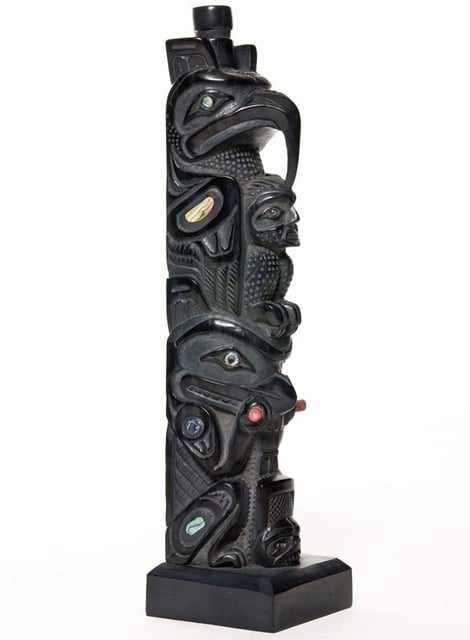
Smaller collector-scale carvings from named artists start in the hundreds of dollars. Our model totem poles are a good starting point for first-time buyers who want an artist-attributed piece for home display without the scale of a full pole.
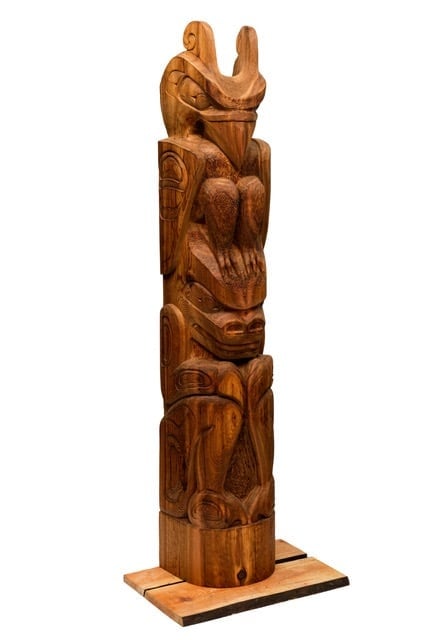
Mid-size gallery pieces in the 24- to 48-inch range generally run into the several thousands. Our 4-foot Eagle Totem Pole is a genuine cedar carving from a renowned Northwest Coast artist and represents the most common entry point for serious collectors. Four gallery pieces are currently in stock, ranging from C$3,000 to C$10,800.
Custom commissioned poles are a different category entirely. Corey Bulpitt, a notable Haida artist, works to commission through Cheryl's Trading Post. His poles range from 2 to 60 feet and are priced at C$7,500 to C$10,000 per foot depending on size and design complexity, meaning a large monumental pole can reach well into the hundreds of thousands. You input the crest figures within Haida cultural guidelines, and completion takes one to two years. View the Custom Haida Totem Poles listing for full details.
Commissioned Work vs. Gallery Pieces
A gallery piece is a carving that already exists: priced, documented, and available to examine before purchase. A commissioned piece is one you create with the gallery mediating with the artist, agreeing on the figures, scale, and story before a deposit is paid and the carving begins.
Commissioning is possible through galleries with direct artist relationships, but it takes time — typically months for smaller pieces and up to a year or more for anything significant. An artist who carves with integrity will tell you which figures belong on a piece and which do not; that conversation is part of the commissioning process.
For most buyers, a gallery piece from a named artist is the right starting point. Browse our current Northwest Indigenous Carvings collection to see what is available.
Documentation to Keep With Your Carving
When you purchase an authentic Northwest Coast carving, request and retain: a certificate of authenticity with the artist's full name, nation, and band or community affiliation; the title, medium, size, and date of the work; a photo of the artist's signature where applicable; and the gallery's contact information and authenticity policy.
Keep this documentation with the piece permanently. If you resell, gift, or donate the work, the documentation is what establishes provenance and preserves the cultural context for whoever holds it next.
Our guide on how to preserve your Northwest Indigenous carvings covers climate, light, cleaning, and long-term display once you have your carving at home.
FAQ
How do I know if a totem pole carving is really Indigenous-made?
Ask for the artist's full name and nation. A legitimate gallery provides both without hesitation. If the seller cannot name the artist or confirm their national affiliation, the piece is not authentically attributed regardless of how the listing reads.
Does the Indian Arts and Crafts Act protect buyers?
It creates legal accountability for US sellers who misrepresent items as Native American-made. If a US seller cannot confirm the artist's enrollment in a federally or state-recognized tribe, you have a basis to question the claim. Suspected violations can be reported to the Indian Arts and Crafts Board at doi.gov.
Can I commission a custom totem pole?
Yes, through galleries with direct artist relationships. Timelines vary from a few months for smaller pieces to a year or more for major carvings. Contact us to discuss what is possible within your timeline and budget.
What size totem pole carving works in a home?
Most home collectors start with pieces between 12 and 36 inches. Pieces over 10 feet are better suited to outdoor settings, dedicated display spaces, or institutional contexts.
Is buying a totem pole culturally appropriate?
Purchasing an artist-attributed carving from an Indigenous-owned gallery that represents the tradition directly is a form of cultural support.
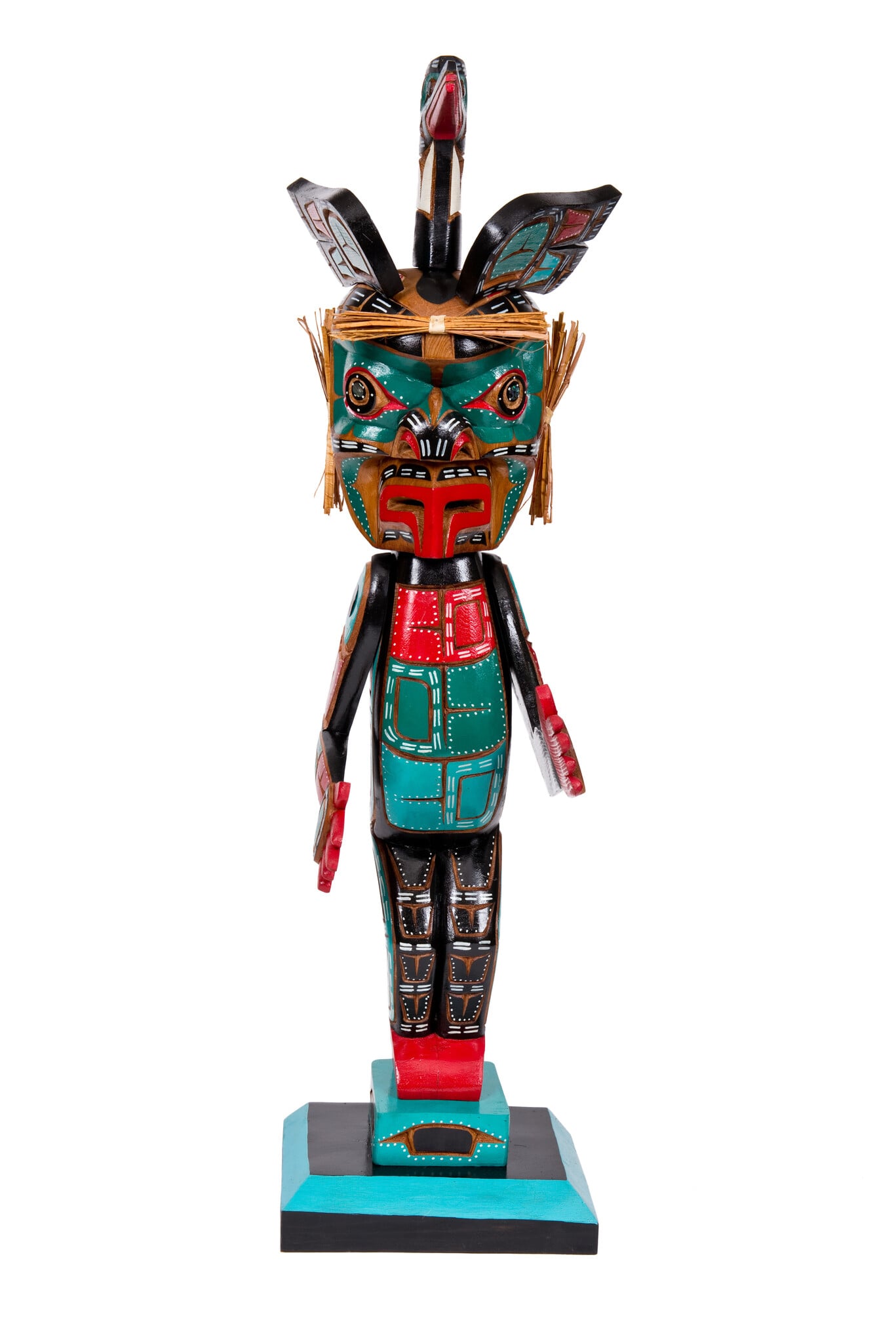
Browse our totem poles and model totem poles if you are ready to find a piece.
- Understanding "Old Pawn" Navajo Jewelry: What It Means and Why Collectors Seek It
- Navajo Jewellery Symbols Explained: Squash Blossoms, Naja Pendants, and Sandcast Rings
- Cowichan Sweater Gift Guide: Choosing the Right Design and Size for Someone Else
- Custom vs Ready-to-Buy Indigenous Masks: What Collectors Should Know
- Types of Indigenous Masks: Transformation, Portrait and Ceremonial
- The Roles of Singing and Music in Traditional West Coast Indigenous Cultures
- How to Choose an Authentic Totem Pole Carving: A Buyer's Guide
- Totem Poles Explained: Meanings, Types and Cultural Significance
- How to Authenticate Northwest Coast Wood Carvings: Tool Marks, Materials, and Artist Signatures
- The Role of Formline Design in Northwest Coast Carving: Understanding the Visual Language
Share this on:


Comments
Be the first to comment...