The Role of Formline Design in Northwest Coast Carving: Understanding the Visual Language
- Posted on
- 0
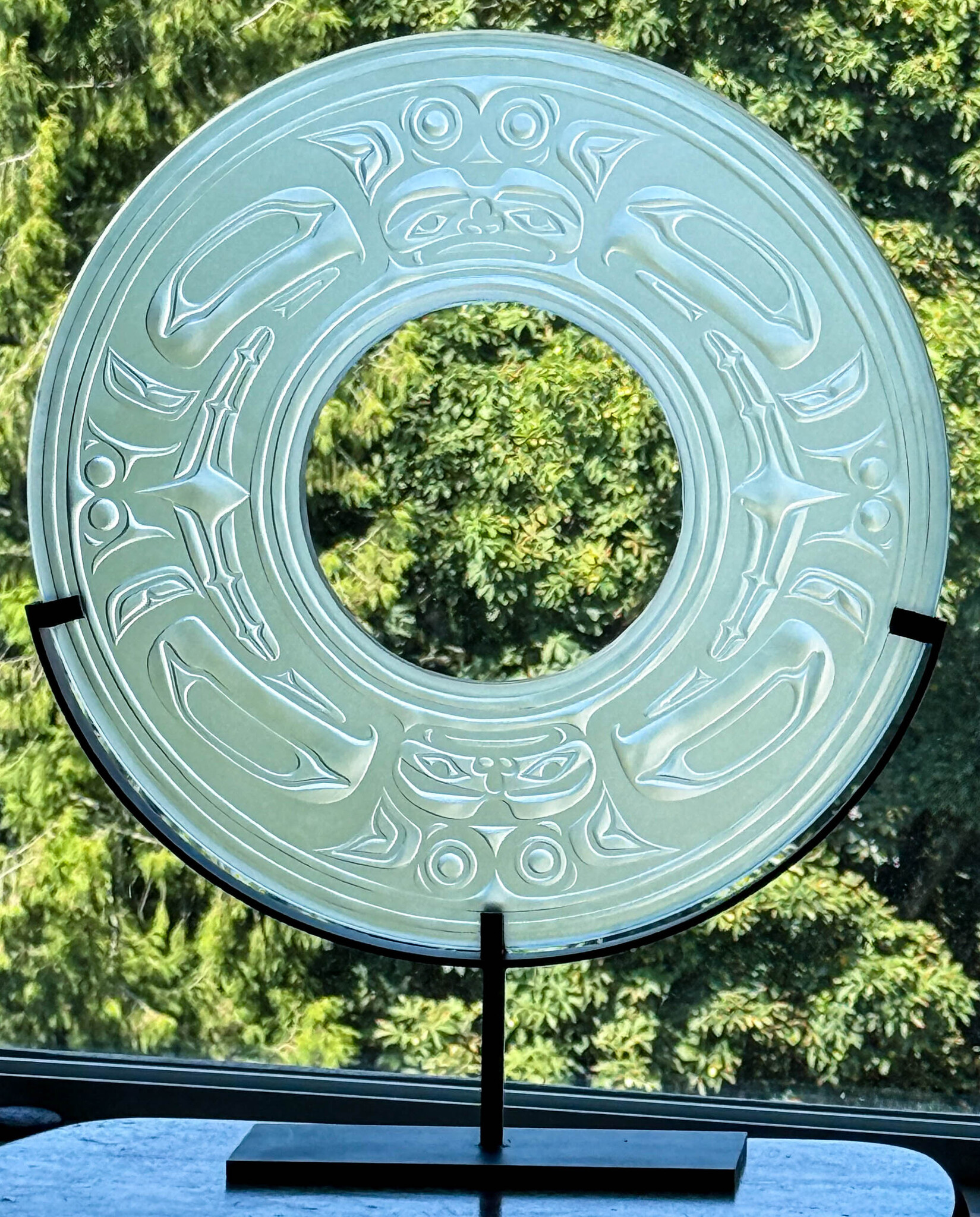
Pick up any piece of Northwest Coast carving, a mask, a wall panel, or a bracelet, and you're looking at a visual system refined over centuries. The flowing shapes, the bold outlines, and the way figures seem to interlock and breathe: that is formline design. It's not decorative in the same way that a pattern on wallpaper is ornamental. It's a structured design language with specific rules, a defined vocabulary, and deep roots in the nations of the Northwest Coast.
Understanding how formline works changes how you see the art. This guide explains the core elements of formline design, how they're used in carving, and why the same visual logic appears across masks, panels, jewellery, and totem poles.
What formline design is
Formline is a design system developed by Northwest Coast artists, primarily among Haida, Tlingit, Tsimshian, Gitxsan, and related northern nations, in which the main visual elements are continuous, swelling lines that define figures and create compositional flow. The term was introduced in the 1960s by art historian Bill Holm, who studied the underlying structure of Northwest Coast two-dimensional design and named what he found.
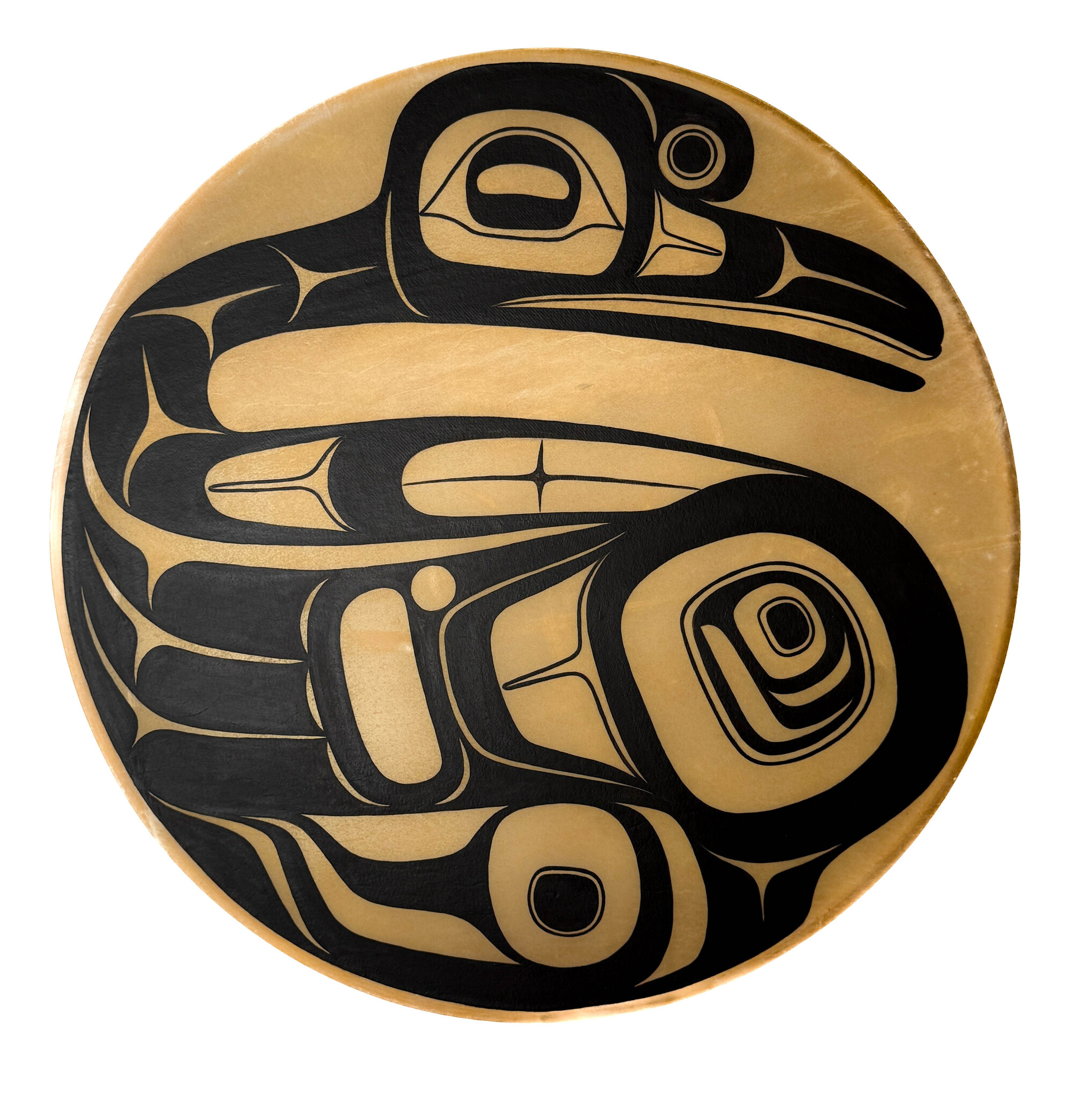
The core of formline is not a set of images but a set of shapes and rules for how those shapes relate to each other. The most important of these shapes are the ovoid, the U-form, and the S-form.
The three building blocks: ovoid, U-form, and S-form
Ovoid
The ovoid is an irregular oval, wider in the middle, with corners that are slightly squared off rather than perfectly round. It appears constantly in Northwest Coast art as an eye socket, a joint, a negative space, or a compositional anchor. On a well-executed piece, ovoids have consistent weight and internal proportions. When an ovoid is off, too round, too elongated, or asymmetrical in the wrong way, the whole composition loses balance.
Look for ovoids wherever a figure has a face: in carved masks, panel figures, totem pole crest figures, and engraved jewellery alike. The shape and placement of the ovoid are one of the clearest signals of an artist's skill and training.
U-form
The U-form is precisely what it sounds like: a shape that opens at the top in a rounded U. It appears as a secondary design element, filling the spaces between primary formline shapes and giving the composition its sense of movement. U-forms can be simple or split (divided by an inner line), and they're often stacked or nested against each other to fill negative space without creating clutter.
In carving, U-forms most commonly represent feathers, fins, tails, and limb joints. Their orientation, which direction they open, is part of the compositional grammar. An upward-opening U-form reads differently from a sideways one, and experienced artists use that directional quality to guide the viewer's eye through the figure.
S-form
The S-form appears throughout Northwest Coast design as a transitional element, connecting or separating primary and secondary shapes. It creates tension and movement within a composition and is particularly useful where two U-forms meet at a corner. Without S-forms, a complex composition can feel stuck in place; with them, the design appears to turn and flow.
Primary and secondary Formline design uses a hierarchy. Primary formline defines the main contours of a figure, the outline of a body, the major feature boundaries, and the dominant visual path through the composition. It is usually the heaviest line weight and forms a continuous network across the piece.
The secondary formline fills the spaces between primary elements with U-forms, split U-forms, and smaller ovoids. It supports the primary figure without competing with it. The relationship between primary and secondary determines whether a design reads as clear and powerful or cluttered and confused.
In carving, this hierarchy is achieved through relief depth. Primary formline elements tend to sit higher—closer to the viewer—while secondary elements are recessed. The shadows created by that difference in depth do much of the work of making a composition readable at a distance, which matters particularly for wall panels and plaques where the interplay of raised and recessed surfaces gives each piece its characteristic depth.
How formline functions across different carving types
Masks and headdresses
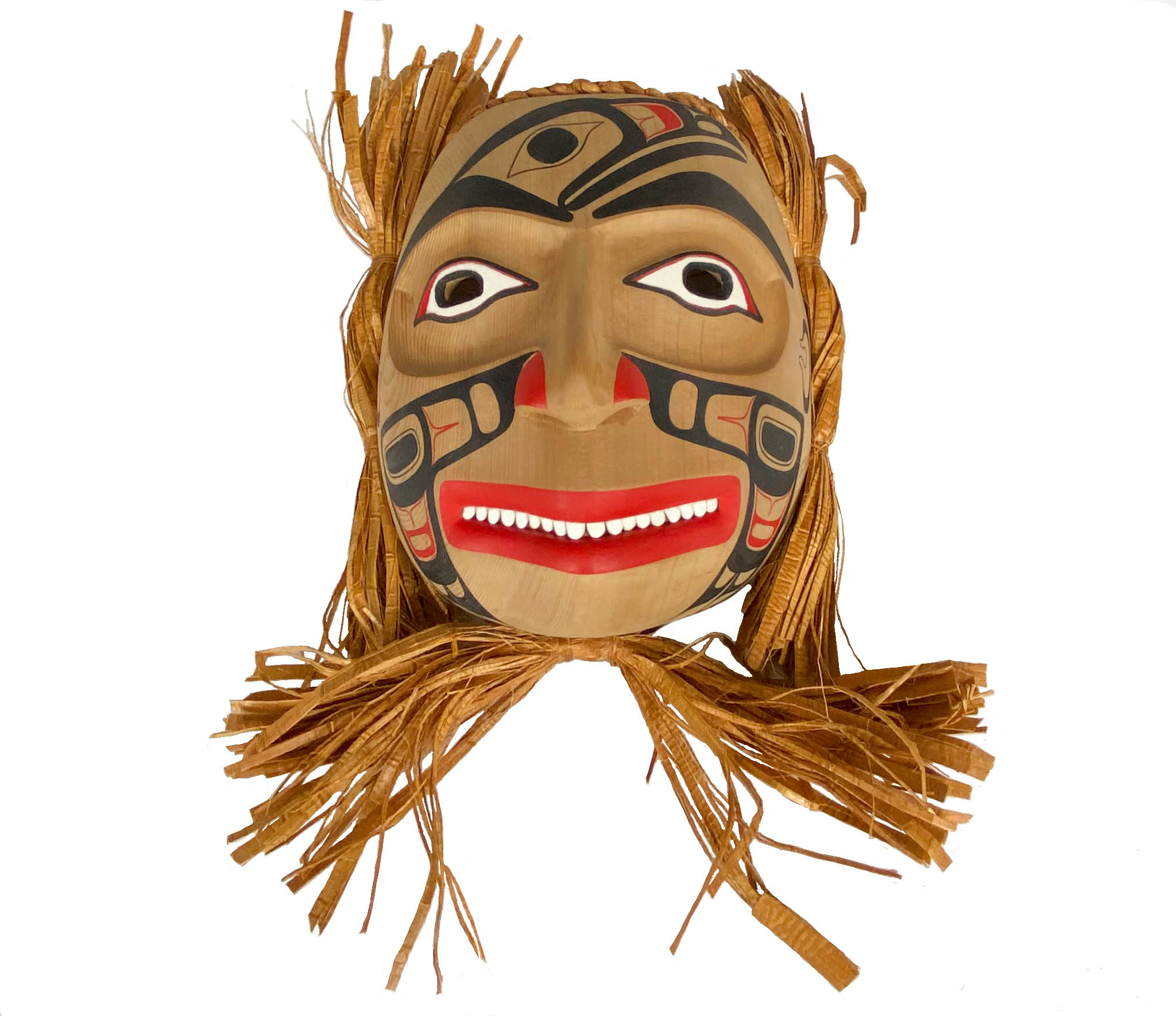
Formline design is used primarily on flat surfaces like in box designs or wall panels. It appears on masks in the painted designs on the surface although there are some formline elements in the carving of the mask itself. The Haida portrait mask below has raven's beak painted on the forehead. Wings with ovoids and u-shapes are also painted on the cheeks. Artists who carve masks and headdresses must plan the design to remain readable from the front, and also while worn in movement.
Wall panels and plaques
Flat panels are where formline's two-dimensional logic is most visible and most unforgiving. There's no sculptural form to carry the design; every line and shape must do its own work. Good formline panel design uses negative space as deliberately as positive space; the gaps between shapes are as intentional as the shapes themselves.
For collectors, panels are often the best starting point for reading formline because the design is visible all at once. A well-composed panel lets you trace the primary formline network from any point and follow it continuously around the figure.
Totem poles
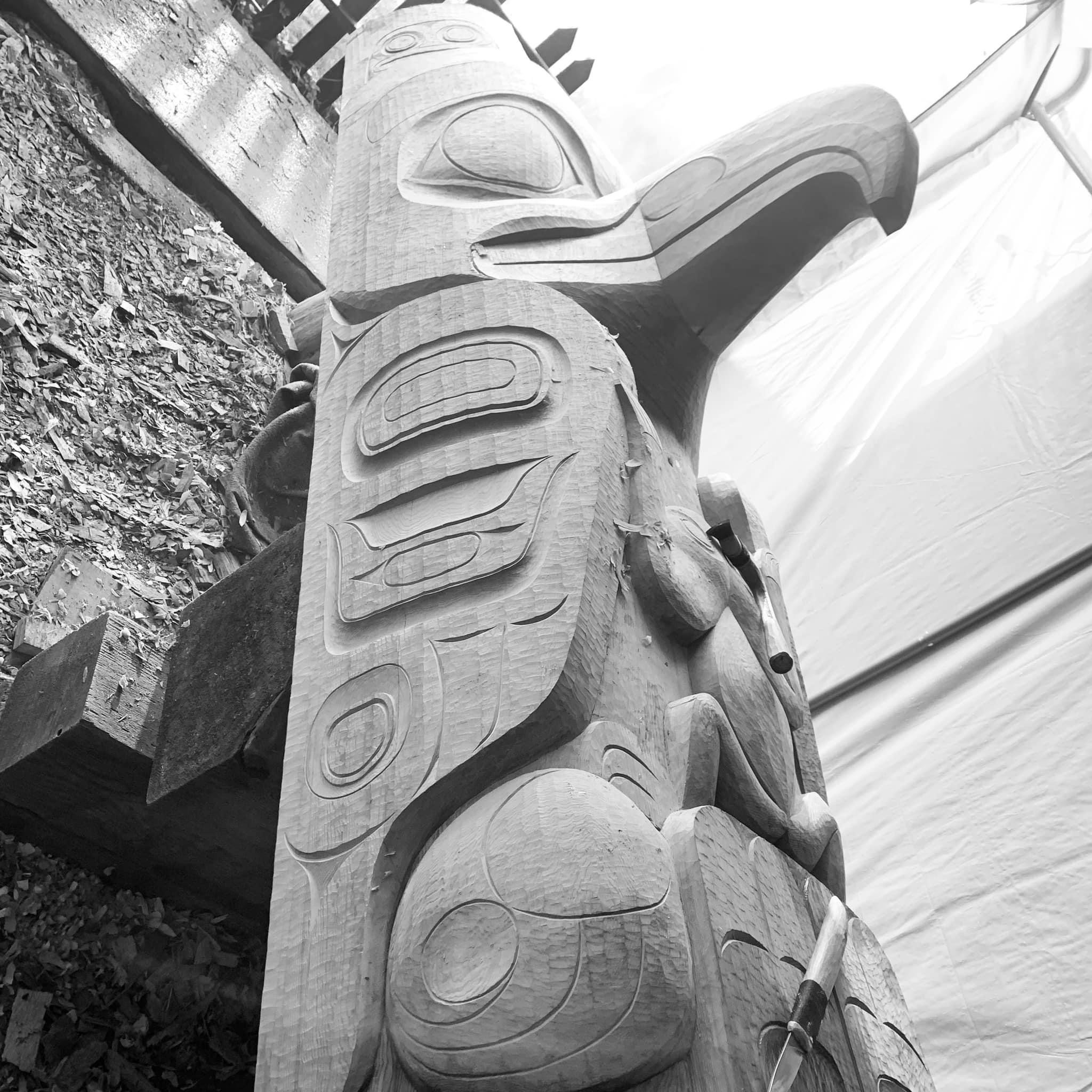
On a totem pole, formline organizes not just individual figures but also the visual relationships between stacked figures. Each crest figure has its own formline structure, but the figures must also connect vertically; the base of one figure's design needs to transition into the crown of the figure below without visual collision.
Scale also changes the demands on the formline. Details that read clearly at arm's length may disappear at twenty feet. Experienced pole carvers exaggerate key ovoids and simplify secondary formline to maintain readability at a distance. Browse totem poles to see how these scale decisions play out across different sizes and styles.
Boxes, chests, and paddles
Formlines on boxes and chests must work across four connected panels; the design wraps the form, and each face relates to the next. Paddles present a different problem: the design runs along a form that tapers and has structural requirements, so the formline has to adapt to the blade's geometry without looking stretched or compressed.
Formline in Northwest Coast jewellery
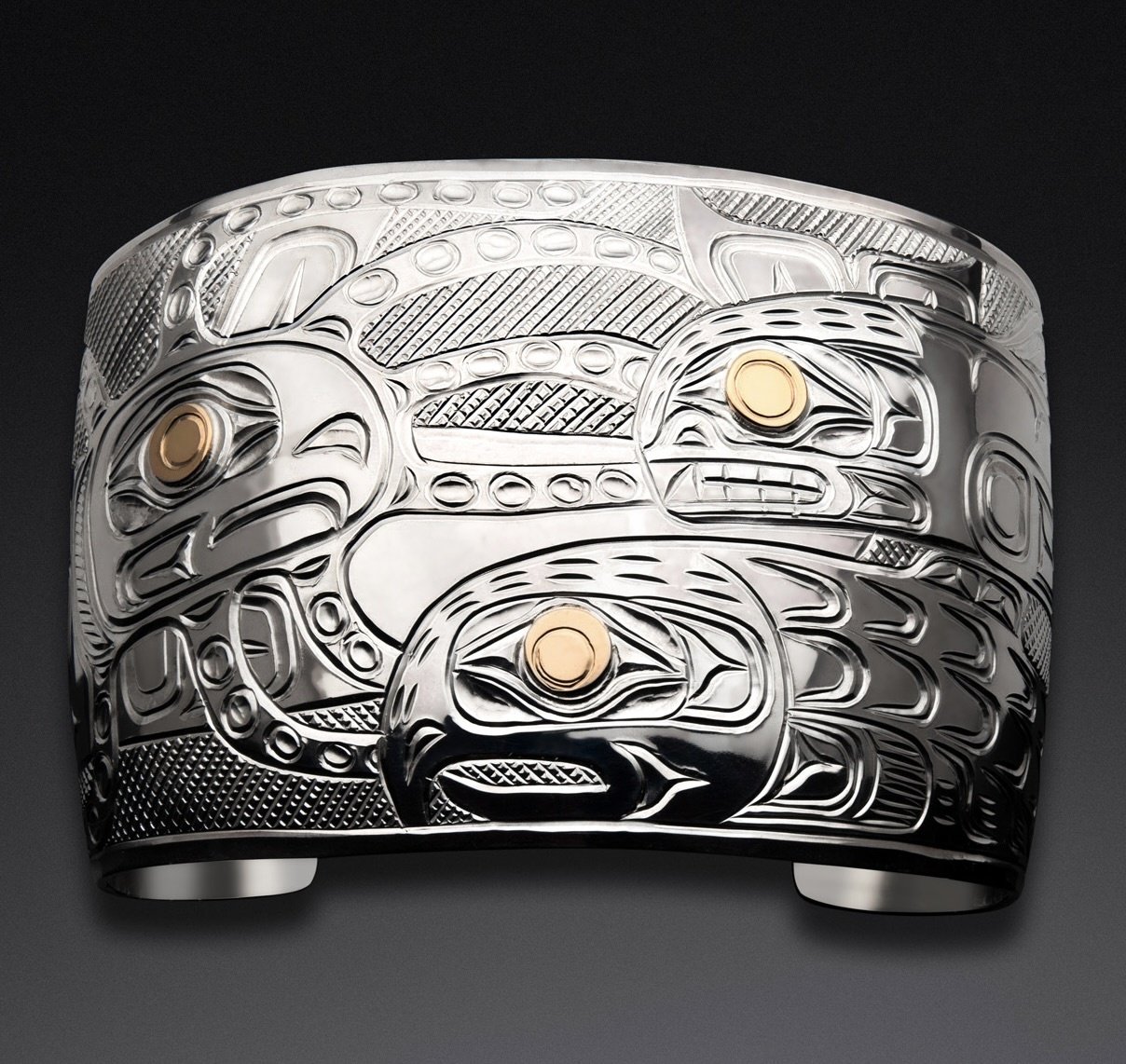
Formline design is not limited to wood carving. It appears throughout Northwest Coast jewellery, engraved on silver and gold bracelets, pendants, and rings, and particularly in Haida jewellery and carvings. The same rules apply at a small scale: Ovoids define eyes and joints. U-forms fill secondary spaces, and the primary formline creates the figure's continuous outline.
The challenge in jewellery is miniaturization. An oval that is two inches wide on a wall panel must become a quarter-inch shape on a bracelet cuff without losing its proportions. On a Northwest Coast bracelet, every element is close to the viewer's eye; there's nowhere for weak formline to hide.
Argillite carving presents its variation. The dense, fine-grained black stone associated with Haida artists allows detail that cedar can't easily hold, and formline in argillite often appears crisper and more linear than in painted cedar work. For more on that material, see Argillite Carvings: The Sacred Black Stone of Haida Gwaii.
Nation-specific differences within the formline system
Formline is a regional visual language, not a single, fixed style. Haida formline tends toward tight, symmetrical compositions with strong primary formline networks and bold ovoids. Tsimshian work often uses softer transitions. Kwakwaka'wakw carving may incorporate more three-dimensional transformation, which requires form lines to adapt across complex surface geometries.
Coast Salish design uses a related but distinct visual vocabulary: circles, crescents, and trigons rather than ovoids and U-forms. Coast Salish art is not usually described as formline design, though it shares the same underlying principle of structured, rule-based visual organization. The Collector's Guide to Northwest Coast Indigenous Carvings provides a practical overview of the nation-specific approaches that highlight the differences in carving traditions you will encounter.
Reading formline on a piece you're considering
Understanding formline gives you a more reliable way to assess quality. When looking at a piece, consider these questions:
• Primary formline continuity: Can you trace the main outlines continuously around the figure, or do they break and restart inconsistently? Well-resolved primary formline forms a network with no loose ends.
• Ovoid quality: Are the ovoids consistent in shape and weight across the piece? Do they have that characteristic slightly squared-off corner? Weak ovoids, too round or too elongated, often signal less confident draughtsmanship.
• Secondary fill: Are the U-forms doing their job of filling negative space without competing with primary elements? The secondary formline should feel subordinate, present, but not demanding attention.
• Depth hierarchy in carving: Does the primary formline sit forward and secondary elements recede? Flat relief, where everything sits at the same depth, misses the shadow contrast that makes a composition readable.
• Consistency across the piece: Formline should use the same visual logic throughout. A well-composed piece has no areas that look like they were designed separately from the rest.
These questions apply whether you're looking at a wall panel, a mask, a carved bowl, or a bracelet. For a broader look at what else distinguishes quality carving, see How Northwest Coast Indigenous Wood Carvings Are Made and Traditional Indigenous Wood Carving: Materials, Tools and Techniques.
Seeing formline in the work
Formline design is worth learning because it's the grammar of a large part of Northwest Coast visual culture. Once you can identify an ovoid and understand why it sits where it does, or follow the primary formline path across a figure and see how it organizes everything around it, the art becomes much more legible.
To spend time with the design system directly, browse the Northwest Indigenous Carvings collection, where panels, masks, poles, boxes, and paddles from across the region show formline working at different scales and in different carving traditions. If you have questions about a specific piece, get in touch directly.
Comments
- Caring for Your Northwest Coast Silver Bracelet: Cleaning, Storage and Tarnish Prevention
- Men's vs Women's Northwest Coast Bracelets: Design Differences and How to Choose
- Northwest Coast Bracelet Sizing Guide: How to Measure Your Wrist for the Perfect Cuff Fit
- Understanding "Old Pawn" Navajo Jewelry: What It Means and Why Collectors Seek It
- Navajo Jewellery Symbols Explained: Squash Blossoms, Naja Pendants, and Sandcast Rings
- Cowichan Sweater Gift Guide: Choosing the Right Design and Size for Someone Else
- Custom vs Ready-to-Buy Indigenous Masks: What Collectors Should Know
- Types of Indigenous Masks: Transformation, Portrait and Ceremonial
- The Roles of Singing and Music in Traditional West Coast Indigenous Cultures
- How to Choose an Authentic Totem Pole Carving: A Buyer's Guide
Share this on:


sorry i missed your comment. just saw it now. thanks for your kind words
thanks for your comment. we're happy you enjoyed reading it. We have a lot of Northwest coast wood carvings and carved jewelry available at our online store if you're interested. https://www.cherylstradingpost.com/indigenous-art/
An interesting and articulate article. Thanks