Coast Salish Design vs Formline: The Two Carving Traditions Behind Northwest Coast Wall Panels
- Posted on
- 0
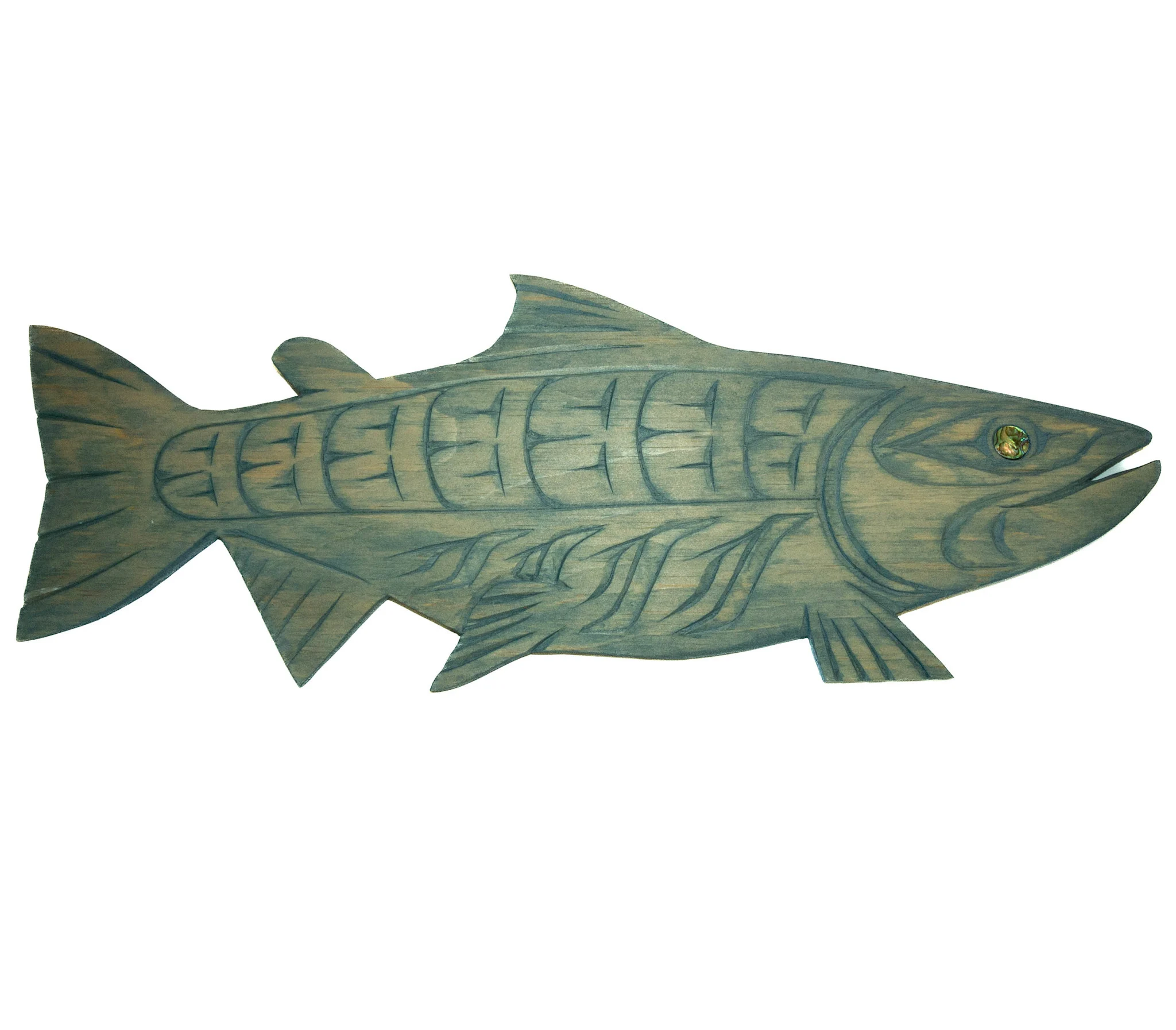
Learn how to tell them apart on a carved wall panel, and which one suits your space.
Coast Salish design and formline are two different visual systems, and both appear on Northwest Coast wall panels. Formline builds a figure from heavy, flowing outlines using ovoids, U-forms and S-forms. Coast Salish design builds it from circles, crescents and trigons, and lets empty space shape the figure. Knowing which one you are looking at tells you where a panel comes from and how it will feel on your wall.
That is the short answer. The rest of this guide shows you how each tradition looks on a carved panel, why the two terms get mixed up, and how to choose between them when you browse our Northwest Coast wall panels and plaques.
Coast Salish design vs formline at a glance
| Coast Salish design | Northwest Coast formline | |
| Home territory | The southern coast: southern British Columbia and Washington State | The northern and central coast, including Haida, Tlingit, Tsimshian and Gitxsan nations |
| Core shapes | Circle, crescent, trigon | Ovoid, U-form, S-form |
| How the figure is defined | Balance between positive and negative space | A continuous primary line, with secondary shapes filling the gaps |
| Overall feel | Open, flowing, spare | Bold, dense, tightly composed |
| Design roots | Spindle whorls and other Salish objects | Carved and painted crest designs on boxes, poles and house fronts |
Where each tradition comes from
Formline belongs to the northern coast. Art historian Bill Holm gave the system its name in 1965, after studying how northern artists organize a design around a continuous primary line. The Haida, Tlingit, Tsimshian and Gitxsan are the nations most closely associated with it.
Coast Salish design belongs to the southern coast, around the Salish Sea. Cheryl's Trading Post is based in Surrey, BC, on Coast Salish territory, so this is the tradition outside our door. Cheryl, our founder, is Gitxsan of the Killer Whale Clan, which means formline is part of her own family's visual world. We carry work from artists in both traditions, and the nation behind each piece matters to us.
What formline looks like on a wall panel
A formline panel reads as one connected network. The primary line swells and thins as it travels around the figure. Ovoids mark eyes and joints. U-forms and S-forms fill the spaces in between. Carvers set the primary line forward and the secondary shapes back, and the shadows between them make the figure readable from across a room. Our guide to formline design in Northwest Coast carving explains each of those shapes in detail.
To see formline at work, look at the Gitxsan Eagle Panel with Blue Accents, a 24 by 18 inch red cedar panel by Gitxsan artist Trevor Angus. Bold blue and black paint defines the formline and every secondary detail, while the surrounding cedar is carved and left natural. Corey Bulpitt's Haida panel 'Mouse Woman' shows the same tradition from Haida Gwaii. Our Haida art collection carries it across jewellery, argillite and carving.
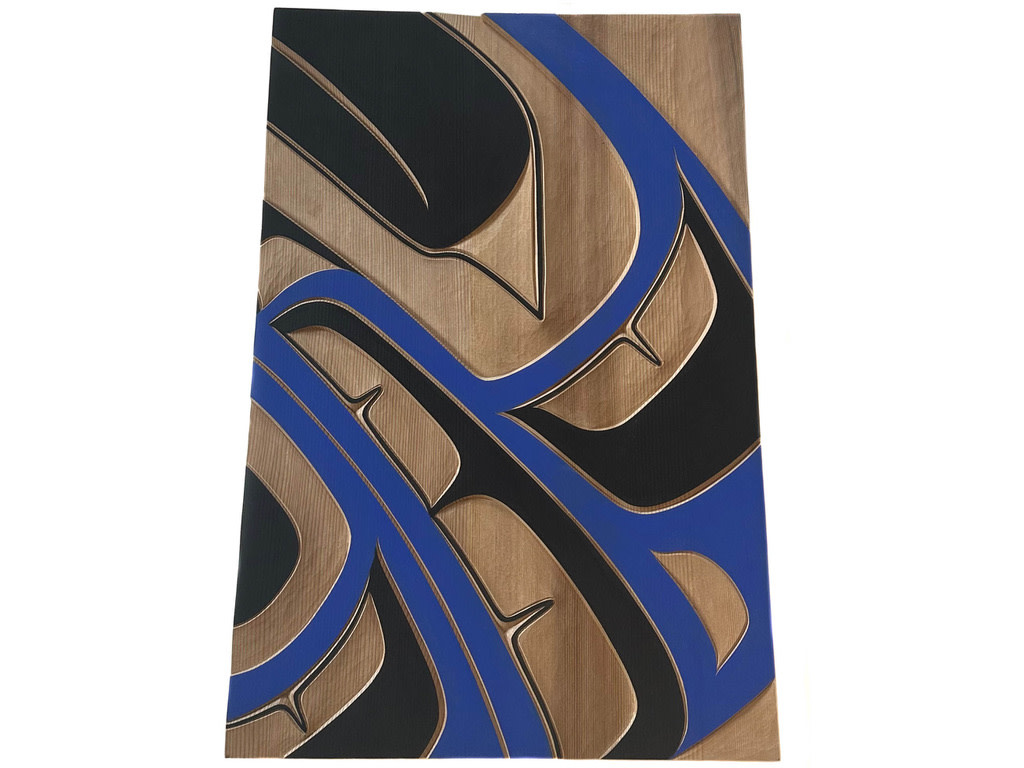
Gitxsan Eagle Panel with Blue Accents by Trevor Angus, northern formline in red cedar.
What Coast Salish design looks like on a wall panel
Coast Salish artists work with a different vocabulary: the circle, the crescent and the trigon, a curved triangle. The figure does not sit inside a strong outline. Positive and negative space flow into each other, so the empty areas carry as much meaning as the carved ones.
Many Coast Salish designs trace back to the spindle whorl, a carved disc used in spinning wool, where a circular field and repeated shapes shaped the composition. On a wall panel, that history shows up as balance and rhythm rather than heavy line. The Coast Salish Bear Panel by Curtis Joe is a 28.5 by 24 inch red cedar panel with a recessed body and round eyes and nostrils that echo the rounded wrist joints. The heart-shaped Coast Salish Double Swan Panel shows the same balance in a different form. Some contemporary Coast Salish carvers also use split U shapes, so treat the shapes in the table as a guide, not a rule.
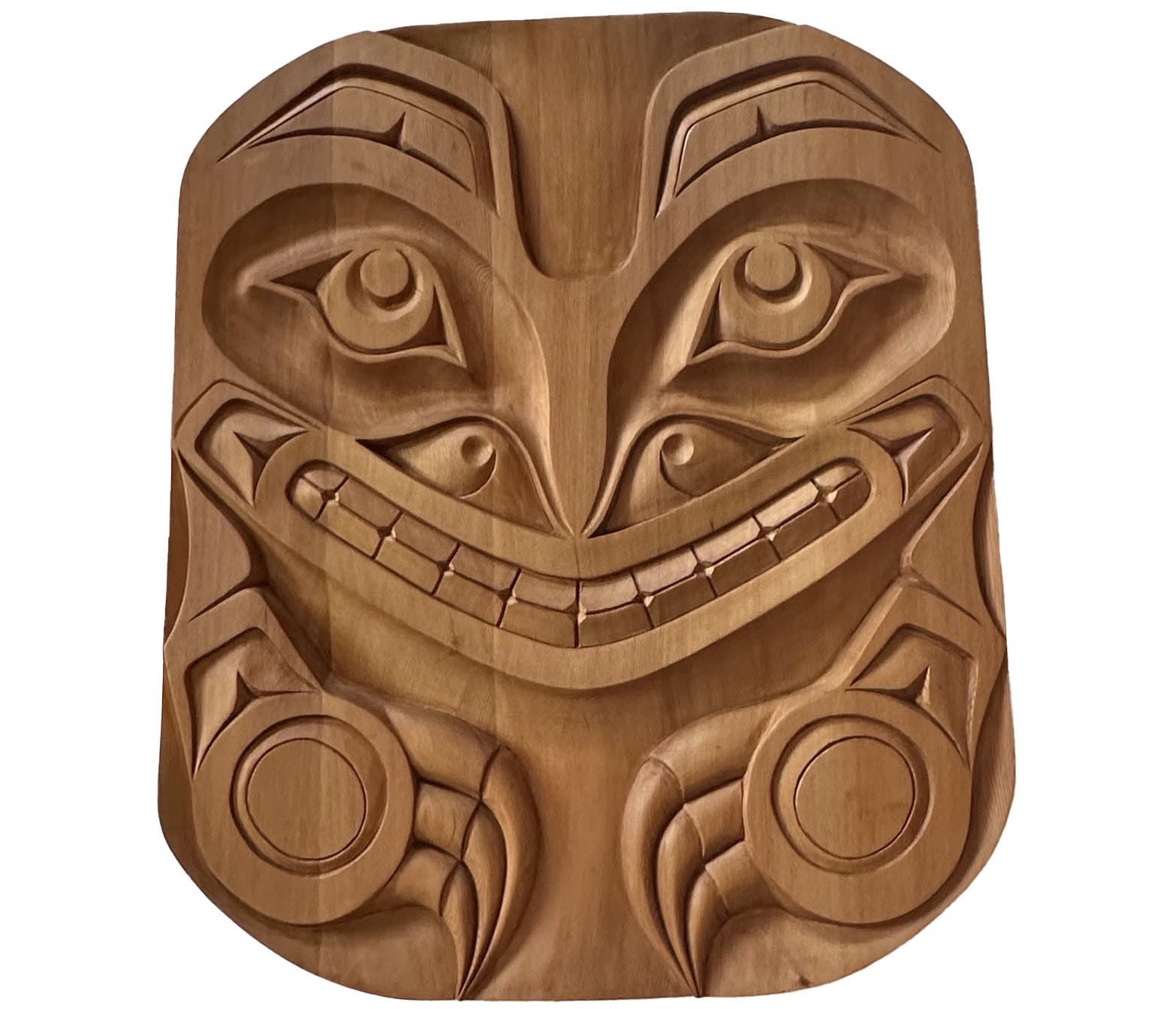
Coast Salish Bear Panel by Curtis Joe, 28.5 by 24 inches, red cedar.
Why the two terms get mixed up
You will sometimes see "Coast Salish formline" in searches and listings. The confusion has a history. In the early 1980s, Musqueam artist Susan Point helped start the current renaissance in Coast Salish art. Like many Coast Salish artists of her generation, she began in the northern formline style, then researched traditional Salish art and returned to Salish design.
So a Coast Salish artist may work in either system, and the artist's nation does not always tell you the style on its own. Coast Salish design is its own system. It is not a type of formline.
Nation and artist matter more than the label
Style categories help you look, but they do not replace the maker. Each nation has its own conventions, and each artist develops a personal hand. Kwakwaka'wakw, Haisla, Nuu-chah-nulth and Gitxsan carvers all work on this coast, and a listing that names the artist and nation tells you more than a style label can. Every panel in our wall panels and plaques collection is listed with the details we have from the artist.
How to tell which tradition a panel belongs to
Four checks work on almost any panel.
- Follow the outline. A heavy, continuous line that swells and thins points to formline. A lighter structure built from separate shapes points to Coast Salish design.
- Name the shapes. Ovoids, U-forms and S-forms belong to formline. Circles, crescents and trigons belong to Coast Salish design.
- Look at the empty space. In formline, the gaps are filled with secondary shapes. In Coast Salish design, the gaps are part of the figure.
- Read the listing. Check the artist's name and nation, then ask us if a detail is missing.
Which tradition suits your space
Neither tradition is better. They answer different questions.
You want a bold focal point. Formline's heavy primary line carries across a room, which suits a main wall, a stairwell or an entry.
You want something quieter. Coast Salish compositions tend to leave room around them, so they sit comfortably beside other art and in layered rooms.
You want a link to place. If you live in southern BC or the Pacific Northwest, a Coast Salish panel connects your home to the territory around you. If your family connection is northern, formline may be the better fit.
You want to match a specific wall. Style is only half the decision. Our room-by-room guide to choosing the right size wall panel covers scale and placement.
You want to know what the figure means. Clan crests such as Eagle, Raven and Killer Whale belong mainly to the northern nations, where they mark family and clan lines. Our guide to reading family and clan crests on wall panels explains how they work.
Frequently asked questions
Is Coast Salish art formline?
No. Formline is a northern design system built on the ovoid, U-form and S-form. Coast Salish design uses circles, crescents and trigons, and relies on negative space. Some Coast Salish artists work in the northern style, but that is a choice of style, not a feature of Coast Salish design.
What are the main elements of Coast Salish design?
The circle, the crescent and the trigon. Artists arrange them so the spaces between shapes carry as much weight as the shapes themselves.
What is the difference between Coast Salish and Haida art?
Haida art belongs to the northern formline tradition, with a strong primary line and tightly composed figures. Coast Salish art uses its own shapes and a more open composition. You can compare both in our Northwest Indigenous Carvings collection.
Which style should I choose for a first wall panel?
Start with the feeling you want in the room and the nation you feel connected to. Then check size and placement. A panel that fits the wall and means something to you is the right choice.
Find a panel that fits your story
Once you know which tradition speaks to you, browse our hand-carved Northwest Coast wall panels and plaques, or explore the full Northwest Indigenous Carvings collection for masks, totem poles and more. If you have a question about a specific piece, get in touch and we will help you choose.
- Reading Family and Clan Crests on Northwest Coast Wall Panels: Eagle, Raven and Killer Whale
- How to Choose the Right Size Wall Panel for Your Space: A Room-by-Room Placement Guide
- Coast Salish Design vs Formline: The Two Carving Traditions Behind Northwest Coast Wall Panels
- Caring for Your Northwest Coast Silver Bracelet: Cleaning, Storage and Tarnish Prevention
- Men's vs Women's Northwest Coast Bracelets: Design Differences and How to Choose
- Northwest Coast Bracelet Sizing Guide: How to Measure Your Wrist for the Perfect Cuff Fit
- Understanding "Old Pawn" Navajo Jewelry: What It Means and Why Collectors Seek It
- Navajo Jewellery Symbols Explained: Squash Blossoms, Naja Pendants, and Sandcast Rings
- Cowichan Sweater Gift Guide: Choosing the Right Design and Size for Someone Else
- Custom vs Ready-to-Buy Indigenous Masks: What Collectors Should Know
Share this on:


Comments
Be the first to comment...