Men's vs Women's Northwest Coast Bracelets: Design Differences and How to Choose
- Posted on
- 0
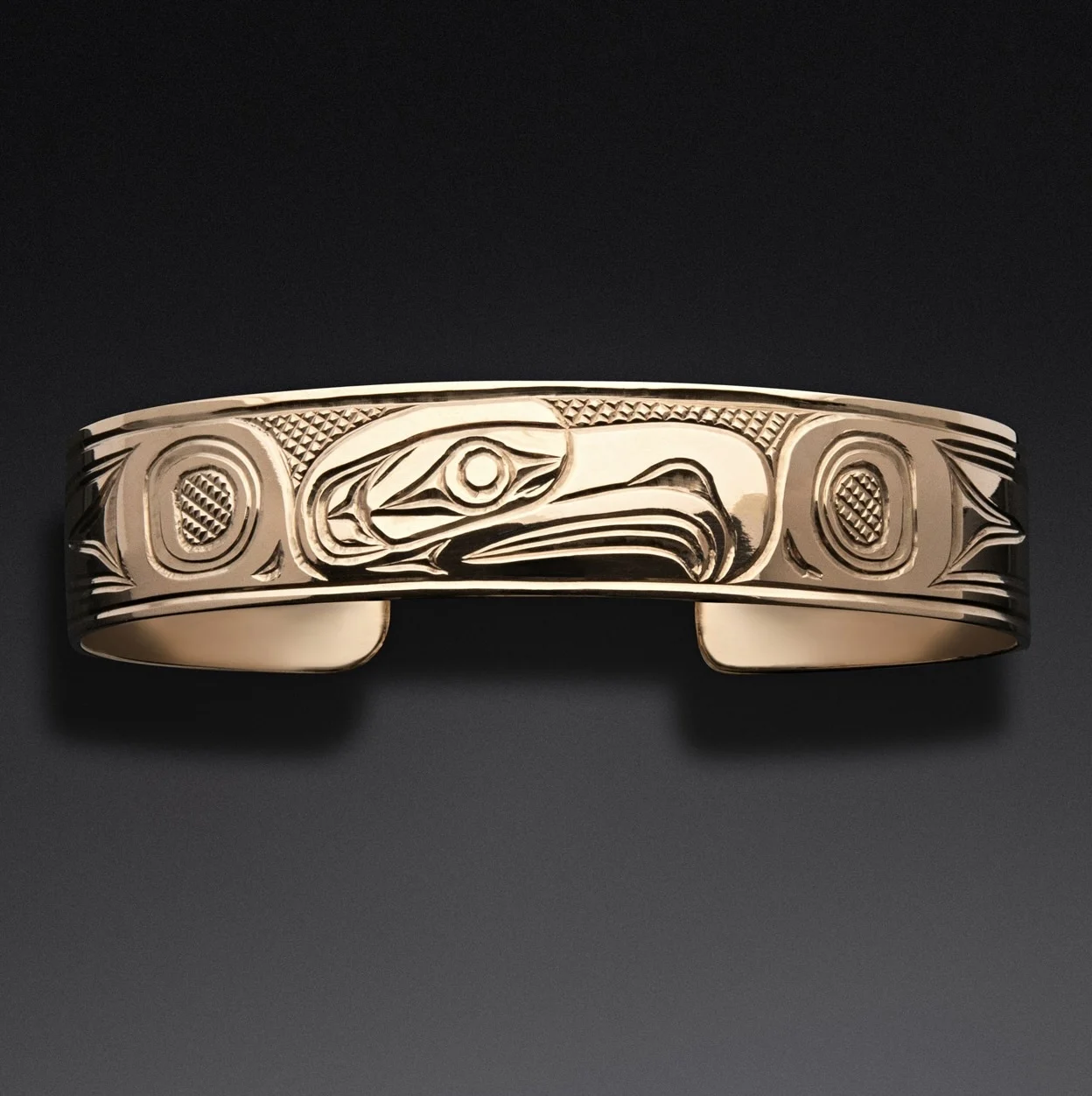
How men's and women's Northwest Coast bracelets differ in length, width and design scale, and how to choose the right Haida or Coast Salish cuff.
There is no traditional rule that makes a Northwest Coast bracelet a man's piece or a woman's piece. Crests belong to families, and men and women have both worn them on silver and gold cuffs. The differences you will see today are practical: in our listings, men's cuffs are longer and wider, with larger-scale carving, while women's cuffs more often come in narrower widths that stack or sit comfortably under a sleeve.
This guide breaks down those differences so you can choose the right piece from our Northwest Coast bracelets, whether you are buying for yourself or for someone else.
Are Northwest Coast bracelets made for men or women?
Both. On the Northwest Coast, a bracelet carries a crest: Eagle, Raven, Bear, Killer Whale, Wolf and many others, each connected to a family's history, rights and responsibilities. That meaning does not change with the wearer's gender. A Killer Whale cuff worn by a mother and one worn by her son speak to the same lineage.
Cheryl, our founder, is Gitxsan of the Killer Whale Clan, and in our family the crest passes through the mother's line. That is part of why we are careful not to label crest figures as "masculine" or "feminine." If you want to understand what a crest can represent, our guide to the meanings of Northwest Coast crest designs is the best place to start.
What does vary is how a bracelet is built. Artists such as Mathew Baker, Alvin Adkins, Liam Baker and Jay Simeon make cuffs across a range of lengths and widths, and those physical choices are what usually make a cuff feel right on one wrist and wrong on another.
Three differences that matter
| Factor | Men's cuffs in our listings | Women's cuffs in our listings |
|---|---|---|
| Length | 7 inches and up (for example 7 and 7 1/4 inches) | 6 1/4 to 6 1/2 inches |
| Width | 1 1/2 to 2 inches | 1/4 to 1 inch |
| Design scale | Wide bands with full or multi-figure designs | A single crest figure, a split design or a flowing formline pattern |
Treat this table as a pattern, not a rule. Plenty of women wear wide cuffs, and many men prefer a slim band that sits under a shirt cuff.
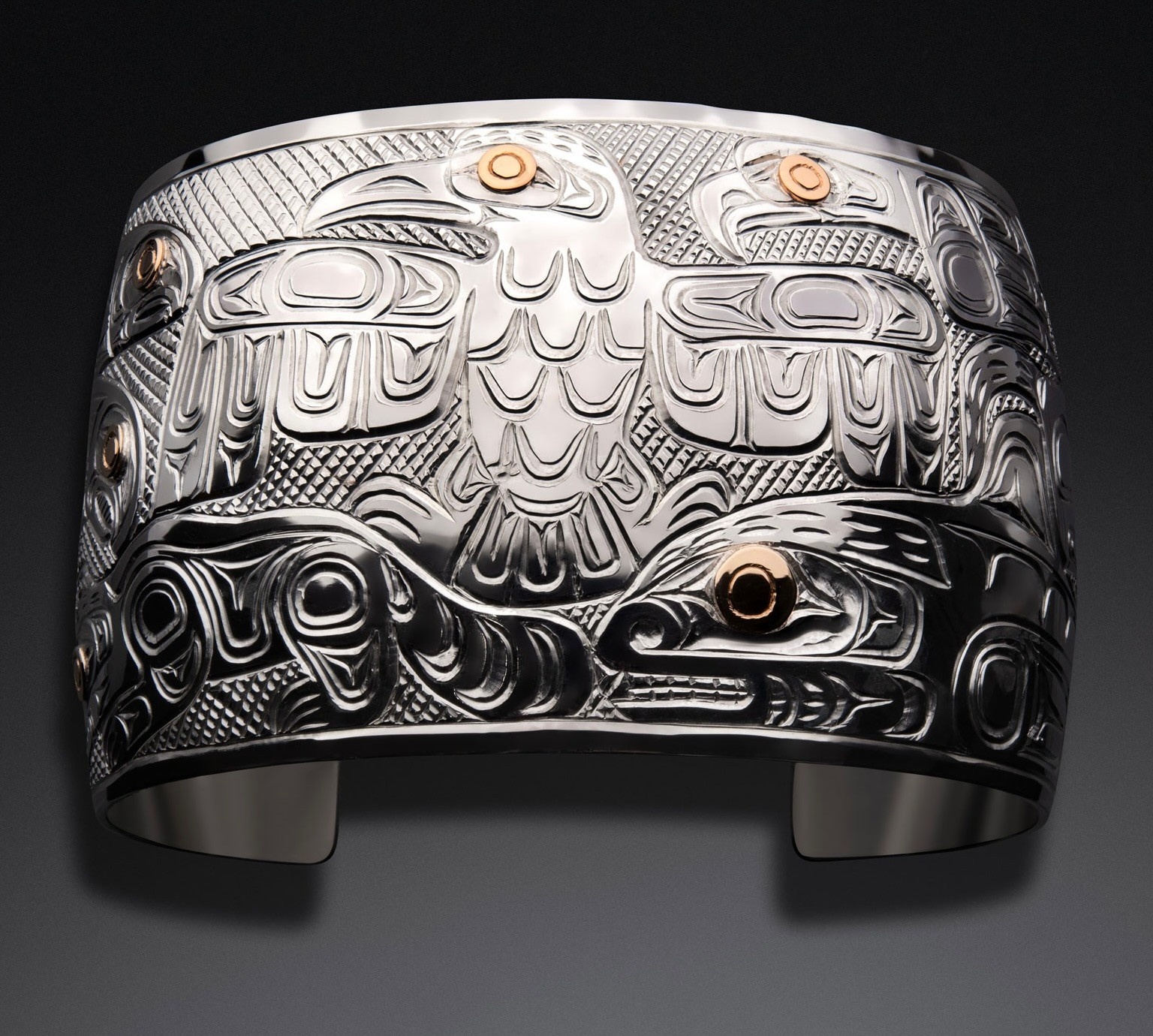
Mathew Baker's Animal Kingdom bracelet is 2 inches wide and 7 inches long, in silver with 14 kt gold eyes. A raven, killer whale, beaver, eagle, wolf and salmon share the band.
Width: the biggest visual difference
Width is the first thing people notice. A 1 1/2 or 2 inch cuff reads as bold from across a room and gives the artist space for a complete crest figure with its head, body and limbs, or several figures, laid out across the band. Narrower cuffs, from about 1/4 inch to 3/4 inch, carry a single figure or a repeating formline pattern and pair easily with a watch or other bracelets.
Width is not only a men's and women's question, though. As we note in our guide to Haida silver and gold bracelets, Haida women often wear multiple wide bracelets. If a woman in your life loves bold jewellery, a wide cuff may be exactly right.
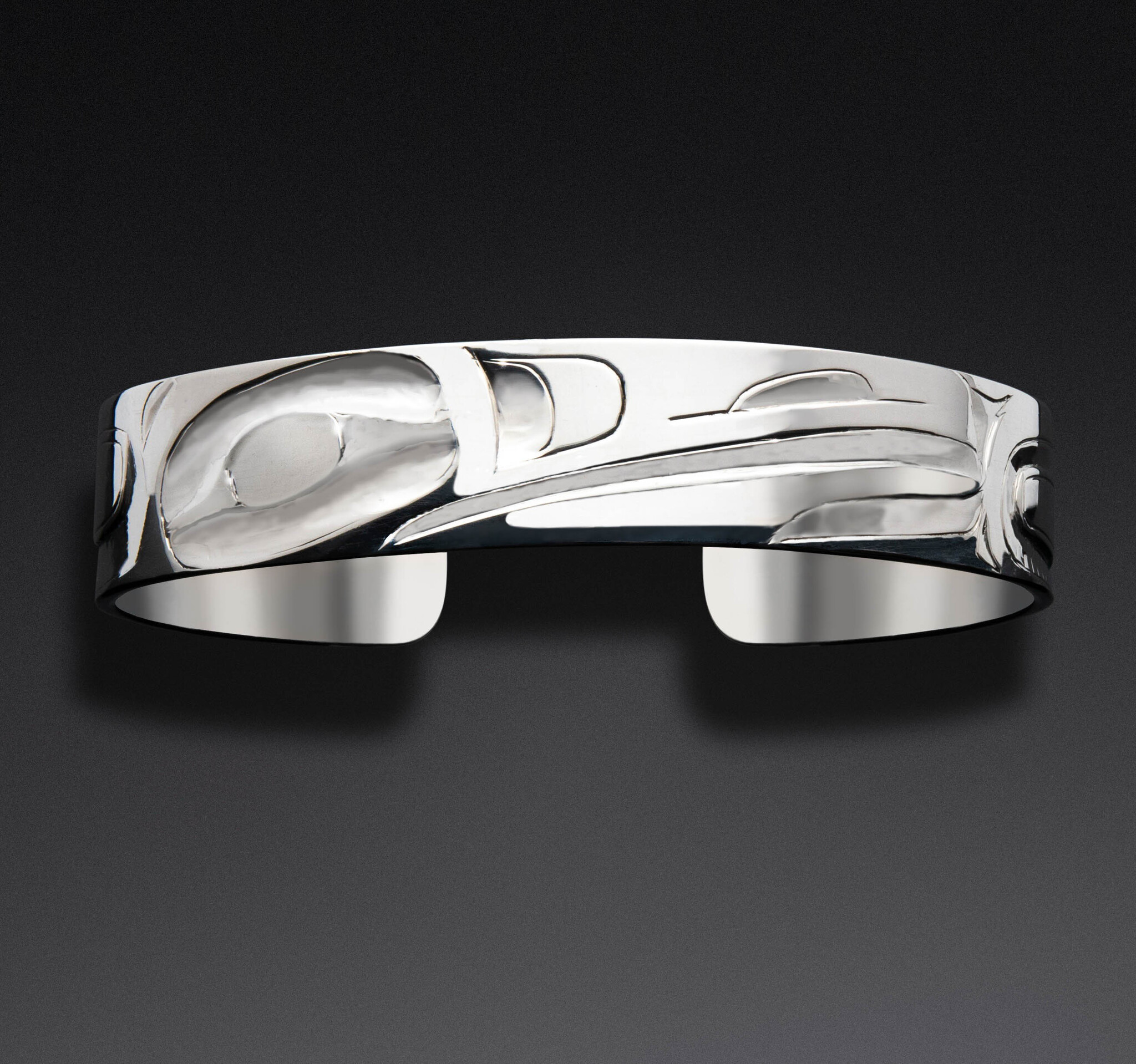
Alvin Adkins's Haida Hummingbird bracelet is 1/2 inch wide and 6 1/2 inches long.
Our Northwest Coast bracelet sizing guide shows how to measure your wrist and read bracelet lengths.
Thickness and profile: how it feels to wear
Two cuffs of the same width can feel very different, depending on the thickness of the silver and the profile of the band. A domed band fits a little more snugly than a flat one of the same length.
Carving technique plays a part here. Engraved cuffs have designs cut into a flat surface, keeping the profile smooth and low. Repoussé cuffs are shaped from behind so the crest figure rises from the band in relief, which gives them a sculptural, three-dimensional look. You can read more about the technique in our post on the art of repoussé.
Think about daily life when you choose. A raised repoussé cuff can catch on a desk edge or a jacket sleeve, while a smooth engraved band slides under a cuff more easily. Someone who works with their hands, or who wears a watch on the same wrist, may be happier with a lower profile.
Length: sizing to the wrist
Men's wrists tend to be larger, so men's cuffs are longer: 7 inches and up is typical, while 6 1/4 or 6 1/2 inches is common for women. A bracelet is usually about the same length as the wrist, measured along the outside of the band, and the opening adds about another inch. Our sizing guide shows how to measure and choose. If you cannot measure the wearer, contact us and we will help you.
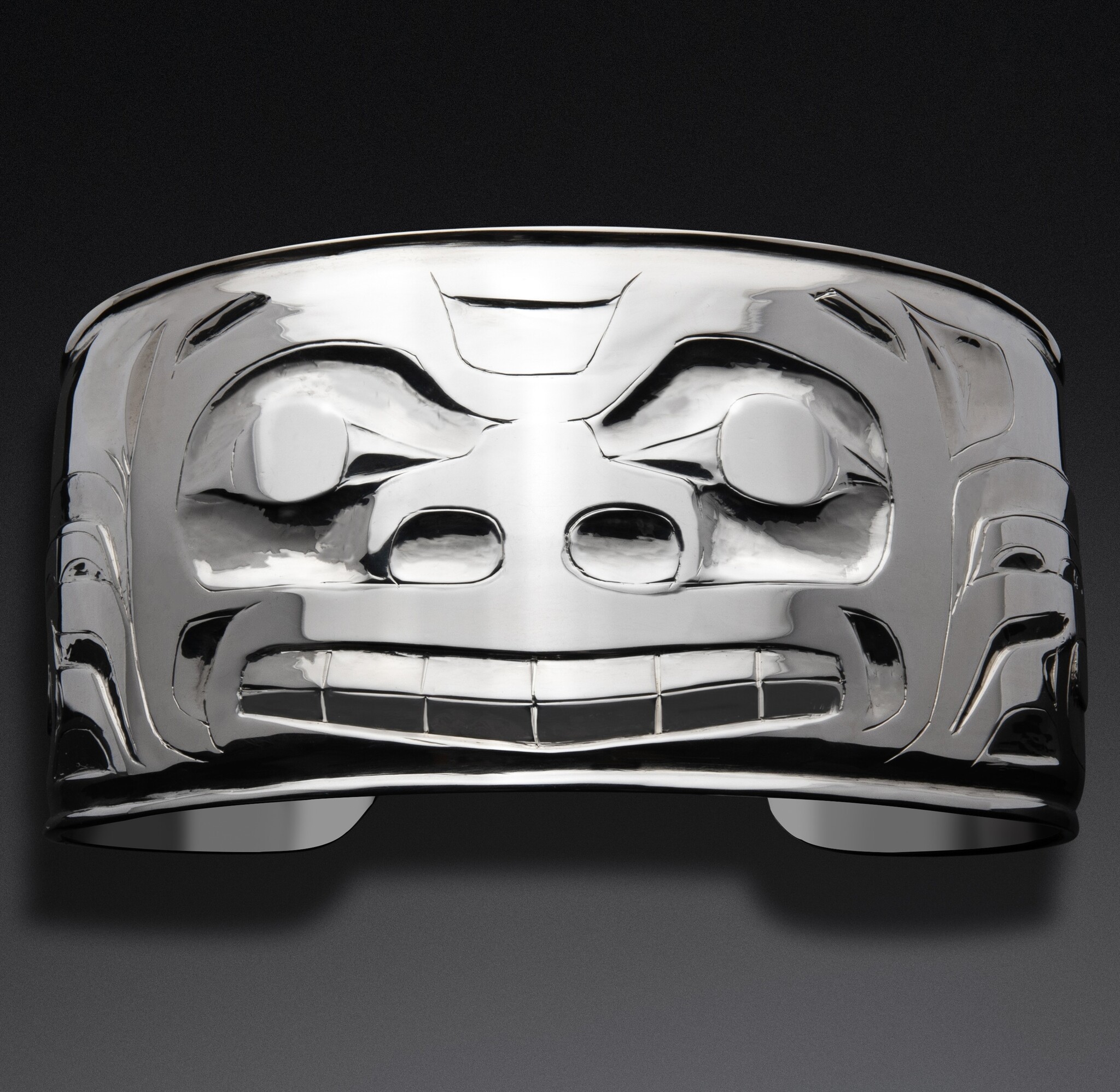
Alvin Adkins's Haida Bear bracelet is 1 1/2 inches wide and 7 1/4 inches long.
Design scale: how the crest is laid out
The width of a band decides how the artist can tell the story. Mathew Baker's silver and gold Bear bracelet, at 1 inch wide, uses a split design: the Bear's head in gold onlay at the centre, with ovoids marking the shoulder, hip and paws, and U-shapes and trigons forming the limbs. On a narrower band, an artist may carve just the head, or a single figure in profile.
Neither is better. A full split design suits someone who wants the crest to be the first thing people see. A smaller-scale design suits someone who wants a piece that reads as personal and close, or who plans to wear it with other jewellery.
Metal choice
Silver, gold and copper are all worn by men and women alike. Silver gives crisp contrast to engraved lines, gold adds warmth and weight, and silver with gold onlay combines the two. Our guide to Haida silver and gold bracelets covers how to match metal to wardrobe and lifestyle, so we will not repeat it here.
How to choose: a quick decision guide
Ask these five questions and the right cuff usually becomes clear.
1) What is the wrist size? Measure first. It narrows the options faster than anything else.
2) Will it be worn every day or for occasions? Daily wear favours a smoother, lower-profile band. Occasions allow for bold width and deep carving.
3) Does the wearer have a crest or clan connection? If so, that decides the design. If not, choose a crest figure whose story resonates with them.
4) What else do they wear on that wrist? A watch or other bracelets point toward a narrower cuff.
5) One statement piece or a collection over time? A single wide cuff makes a strong heirloom. Narrow bands can be added one by one for birthdays and anniversaries.
If nothing in stock fits, the artists who make our bracelets, including Mathew Baker, Alvin Adkins and Liam Baker, take custom orders. You choose the length, width, metal and crest. See custom jewellery by Mathew Baker for examples, or contact us to start one.
Buying a cuff as a gift
Bracelets make a strong milestone gift for graduations, weddings, retirements and significant birthdays. Start with the length, since a cuff that is too short will pinch and one that is too long will slide and spin. Then choose the width and the crest. The best gift reflects how the person actually dresses and what they already wear.
For more ideas by occasion, see our guide to Northwest Coast jewellery as heirloom gifts.
A word on "Haida-inspired" bracelets
Search for Native bracelets for men and you will see copper and alloy cuffs for $40 or less, described as "inspired by" Haida or Alaskan totem art. Those words matter. "Inspired" and "style" usually mean the piece was not made by an Indigenous artist, and the crest designs on them are often copied without permission from the families and artists they belong to.
In the United States, the Indian Arts and Crafts Act makes it illegal to market a product in a way that falsely suggests it was made by a Native American artist or tribe. Every bracelet we carry is made by a named Indigenous artist, and we can tell you who made it and where they come from. If you want to check any piece before you buy, our guide on how to identify authentic Native American jewellery walks through what to look for.
Frequently asked questions
Do Native American men wear bracelets?
Yes. On the Northwest Coast, men and women both wear crest bracelets. Across the Southwest, silver and turquoise cuffs are also widely worn by Navajo, Zuni and Hopi men.
What width cuff should a man wear?
In our listings, men's bracelets are commonly 1 1/2 to 2 inches wide and 7 inches or longer. Someone who wears a watch on the same wrist may prefer a narrower band.
Can a woman wear a men's cuff?
Absolutely. Northwest Coast bracelets are not gendered by tradition. The only real question is fit: a longer cuff made for a larger wrist may need a size check first. We can also adjust the shape for your wrist before shipping.
Is it okay for non-Native people to wear Northwest Coast jewellery?
Yes, when it is bought from Indigenous artists or from galleries that work directly with them. Buying authentic work supports artists and their communities. We see our customers as stewards of the pieces they take home, and we are always glad to share the story behind a crest so it is worn with understanding.
How do I know if a Northwest Coast bracelet is authentic?
Look for the artist's name and nation in the listing, and ask where the artist signs or stamps their work. A reputable seller will give you the artist, the nation and the story behind the piece. Be cautious of listings that use words like "inspired," "style" or "totem design" without naming an artist.
Find the right cuff
Browse our full collection of hand-carved Northwest Coast bracelets in silver, gold and copper, from slim everyday bands to wide statement cuffs. Once you have found the one, our guide to caring for your Northwest Coast silver bracelet will help you keep it looking the way the artist intended.
- Caring for Your Northwest Coast Silver Bracelet: Cleaning, Storage and Tarnish Prevention
- Men's vs Women's Northwest Coast Bracelets: Design Differences and How to Choose
- Northwest Coast Bracelet Sizing Guide: How to Measure Your Wrist for the Perfect Cuff Fit
- Understanding "Old Pawn" Navajo Jewelry: What It Means and Why Collectors Seek It
- Navajo Jewellery Symbols Explained: Squash Blossoms, Naja Pendants, and Sandcast Rings
- Cowichan Sweater Gift Guide: Choosing the Right Design and Size for Someone Else
- Custom vs Ready-to-Buy Indigenous Masks: What Collectors Should Know
- Types of Indigenous Masks: Transformation, Portrait and Ceremonial
- The Roles of Singing and Music in Traditional West Coast Indigenous Cultures
- How to Choose an Authentic Totem Pole Carving: A Buyer's Guide
Share this on:


Comments
Be the first to comment...